


A CEOs Guide to Hiring a CISO
The Top 8 Attributes of a CISO that Benefit Organizations
Introducing

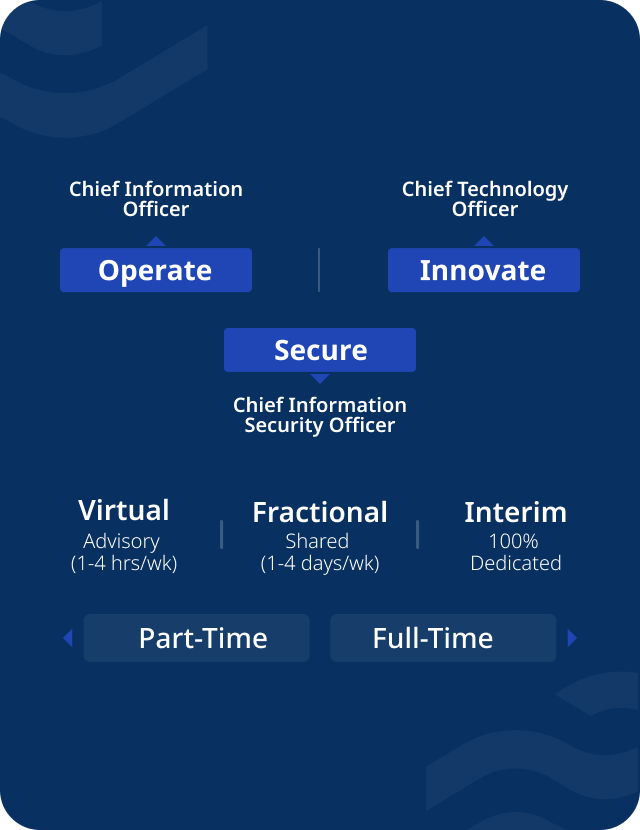
Technology Leadership-as-a-Service® (TLaaS™)

Virtual, Fractional, or Interim Technology Leadership
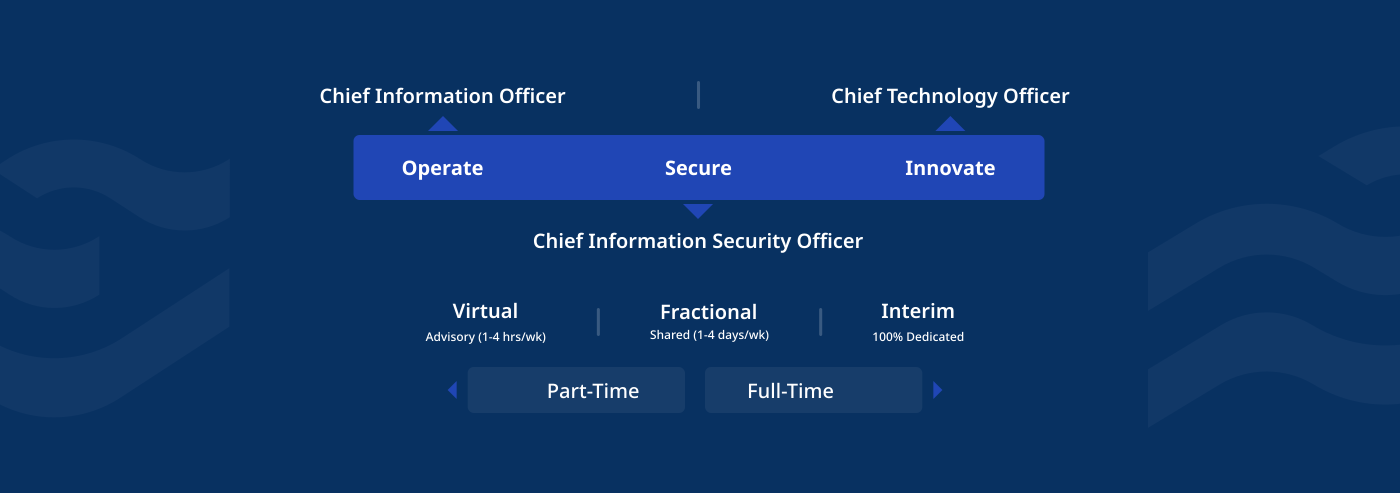
Technology Leadership as-a-Service

How will an Interim CISO Support Your Business Objectives?

understand
Assess and Triage

Understand the organization's security needs and aspirational goals during transition, focusing on critical assets and data protection. 

maintain
Maintain Posture

Maintain the desired security state by continuously iterating: assess, align, remediate, and operate through the transition. 

lead
Executive Presence

Lead, influence, and provide executive presence to the Board and stakeholders during periods of change or after a breach. 

develop
Strategic Spend

Develop a recommended level of security spend aligned with immediate risk remediation and future stability.

Engaging Fortium for an Interim CISO gave us instant secuirty posture clarity and defensive momentum. They quickly identified our critical vulnerabilities, aligned cybersecurity with our risk tolerance, and brought disciplined governance to a roadmap that had been stallled for years. Their ability to balance technical resilience with executive strategy restored confidence across our board and ensured our compliance styaed ahead of the curve. This was not a stopgap, it was a true CISO leadership at the moment our data protection needed it most.

img3
Private Equity-Backed Organization

Board Member

Frequently Asked Questions

Have questions? We're here to help

How quickly can an Interim CISO begin securing our environment?

Immediately - and that speed matters.


Fortium Interim CISOs are proven operators who arrive with battle - tested frameworks for rapid risk assessment. Within days, not months, they establish situational awareness of your threat landscape, regulatory exposure, and control gaps. They quickly prioritize what could cause material harm, assign ownership, and initiate remediation, while ensuring the CEO and Board understand what must be addressed now versus later. Every week without accountable leadership increases exposure.

What differentiates a Fortium Interim CISO from a security consultant or “vCISO”?

Authority, accountability, and executive judgment.


Fortium Interim CISOs are former enterprise security executives - not advisors producing recommendations from the sidelines. They step into true leadership roles with decision-making authority, pattern recognition from real breaches and audits, and the mandate to act. Unlike vCISOs or consultants, they don’t just identify risk - they own outcomes when timing, reputation, and enterprise value are on the line.

What is the most critical immediate value a Fortium Interim CISO delivers?

Immediate executive accountability for cyber risk.


In moments of leadership gaps, incidents, or heightened scrutiny, ambiguity is the enemy. A Fortium Interim CISO takes ownership of the security agenda on day one, providing the CEO and Board with a candid, experience-driven view of actual risk - not theoretical maturity scores - and a prioritized path to resilience. This clarity is often what prevents minor exposures from becoming enterprise events.

When should a company consider an Interim CISO instead of a permanent hire?

When the business cannot afford to wait.


Organizations engage an Interim CISO during inflection points - unexpected leadership exits, post-incident recovery, time-sensitive audits, M&A activity, or stalled security transformations. Searching for a permanent CISO while risk compounds is a costly delay. An Interim CISO stabilizes the function immediately, restores momentum, and creates the conditions for a stronger long-term hire.

Can an Interim CISO manage major initiatives like SOC 2, global privacy compliance, or zero-trust migration?

Yes - and often that’s why they’re brought in.


Fortium Interim CISOs have led these initiatives under real-world constraints. They quickly assume executive sponsor or steering roles, keeping compliance timelines, budgets, and operational priorities intact during transitions. Their involvement reduces the risk of missed deadlines, audit failures, and costly rework when leadership gaps would otherwise derail progress.

What are the risks of operating without an accountable CISO during a transition?

Risk compounds quietly - and expensively.


Without clear security leadership, remediation stalls, decisions fragment, vendors fill the vacuum, and teams lose direction. Over time, investments drift without measurable risk reduction, and executives lose confidence in what is actually being protected. The longer the gap, the harder and more expensive it becomes to regain control.

How does an Interim CISO prioritize security debt without disrupting the business?

By treating security as enterprise risk, not just IT work.


Fortium CISOs triage security debt based on business impact, regulatory exposure, and operational risk - not technical perfection. They sequence remediation to reduce the most material risks first while preserving speed, growth, and customer trust. This disciplined approach prevents security from becoming a drag on execution.

How does an Interim CISO support the board in recruiting a permanent CISO?

By ensuring the next hire fits reality - not theory.


Interim CISOs provide an unbiased assessment of the current environment and help boards define the right leadership profile based on real risk conditions. They assist with candidate evaluation, validating executive presence, decision-making maturity, and crisis readiness—so the permanent CISO enters a stabilized, well-understood environment.

Do Interim CISOs make long-term strategic security decisions?

They make the decisions that cannot wait.


Fortium Interim CISOs are empowered to act decisively to protect the business, meet compliance obligations, and strengthen core security capabilities. At the same time, they document priorities, clarify roles, and create momentum that enables a permanent leader to succeed - without inheriting chaos or stalled initiatives.

How long does an Interim CISO engagement typically last?

As long as necessary to restore control and confidence.


Some engagements last three to six months for stabilization; others extend through major audits, incidents, or transformations. Duration is driven by business readiness - not arbitrary timelines. The objective is always the same: stabilize risk, advance the security function, and transition from a position of strength.

What happens if we delay bringing in an Interim CISO?

Delaying executive security leadership allows risk to compound faster than most organizations realize.


Without an accountable CISO, critical vulnerabilities remain unprioritized, compliance timelines slip, and security decisions fragment across IT, legal, finance, and vendors. Over time, this increases the likelihood of a material incident, regulatory scrutiny, insurance challenges, and loss of board confidence.


In many cases, organizations that delay engaging an Interim CISO ultimately face higher remediation costs, longer recovery timelines, and reduced strategic flexibility. Fortium Interim CISOs are often brought in after an avoidable escalation - when earlier intervention could have limited exposure, preserved trust, and reduced total risk.

Have more questions?

Download our e-book, "The CEOs Guide to Hiring a CISO"

Four Reasons Your Business Needs a Virtual, Fractional, or Interim CISO

Rapid Growth & Regulatory Inflection

As an organization scales, manual security checks and entry-level support become insufficient to protect the brand. An Interim CISO is required when rapid growth triggers new compliance mandates (such as SOC2, HIPAA, or GDPR) that the existing team is not equipped to navigate.

Filling an Urgent Vacancy

Whether a CISO has departed voluntarily or unexpectedly, an organization cannot afford a lapse in oversight. An Interim CISO provides immediate stability and can actively assist the CEO and CHRO in defining the requirements for—and identifying—a permanent successor.

Post-Incident Stabilization or Temporary Leave

During a temporary leave or immediately following a security breach, momentum must be maintained to prevent further risk. An Interim CISO steps in to provide executive presence, manage vendor relationships, and ensure that security discipline does not drift during the absence of the permanent leader.

Closing the "Junior Leadership" Gap

Often, existing security leadership is overly technical or too junior to handle Board-level reporting and strategic risk management. An Interim CISO provides the necessary executive experience to elevate the security function, especially when internal or external changes expose gaps in current capabilities.

Fortium also provides

avtar3

Chief Information Officer (CIO)

A senior technology leader primarily focused on internal technology investment and strategy. The CIO serves as the primary "technology buyer," ensuring that internal systems, infrastructure, and digital transformation efforts align with the organization's broader business goals.

avtar2

Chief Technology Officer (CTO)

A senior technology leader responsible for commercial software product development. Usually found in "technology maker" organizations, the CTO oversees engineering teams and product roadmaps to drive revenue and market competitiveness through technology creation.

avtar3

Chief AI Officer (CAIO)

Senior executive responsible for defining, governing, and accelerating enterprise AI strategy. Focuses on translating AI investments into measurable business outcomes while ensuring responsible use, security, and organizational readiness.