


Introducing

Technology Leadership-as-a-Service® (TLaaS™)

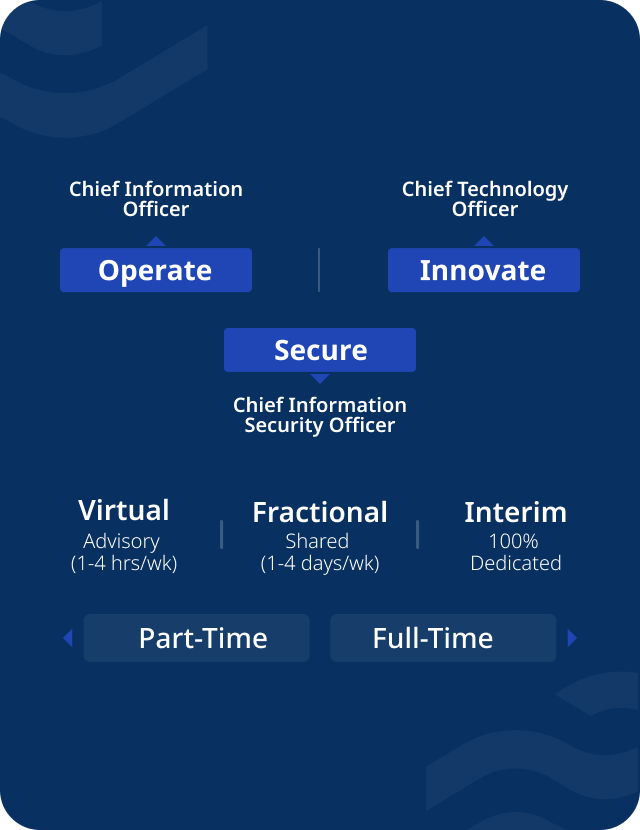
Virtual, Fractional, or Interim Technology Leadership
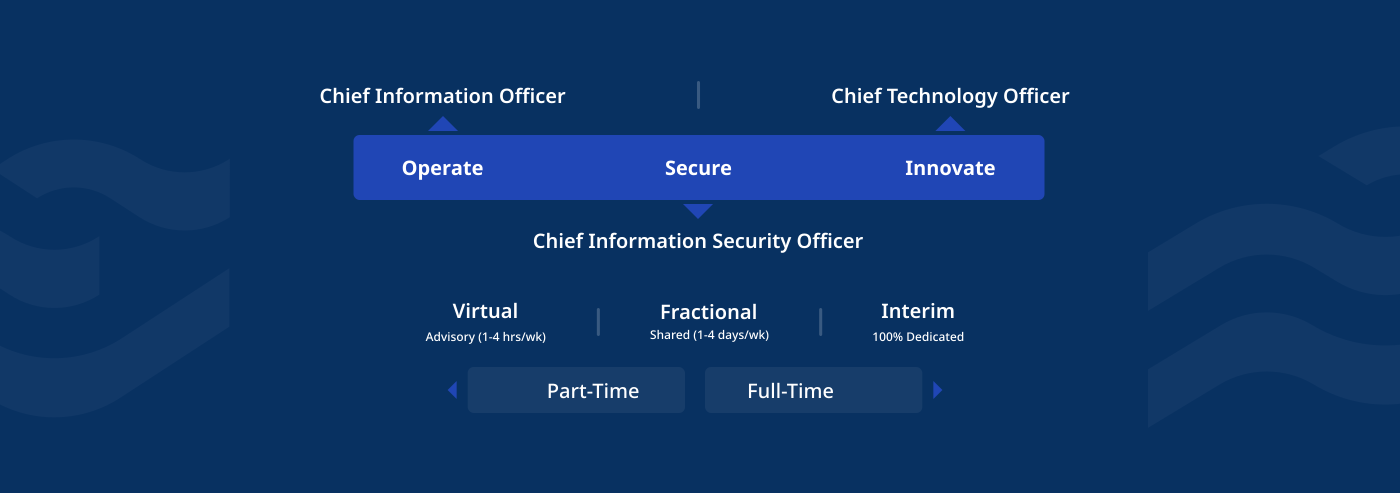
Technology Leadership as-a-Service

How will an Interim CIO Support your Business Objectives?

understand
Understand

The organization's basic needs and aspirational goals during transition

maintain
Maintain

The organization's desired operational state by continuously iterating: assess, align, remediate, and operate through the the transition

lead
Lead

Influence, communicate to, collaborate with, and provide executive presence to stakeholders during periods of change

develop
Develop

A recommended level of technology spend aligned with immediate objectives and future stability

Bringing Fortium in as our interim CIO was one of the most impactful leadership decisions we’ve made. In a matter of weeks, they stabilized our technology environment, clarified our priorities, and gave us a strategic roadmap we could finally execute against. Their assessment was thorough, their communication was transparent, and the results were immediate. For the first time in a long time, our technology function is operating with confidence and direction.

img2
Mid-Market Healthcare Organization

CEO

Frequently Asked Questions

Have questions? We're here to help

When should a company consider bringing in an Interim CIO instead of hiring a permanent one?

Organizations typically turn to an Interim CIO when they face an inflection point - an unexpected leadership vacancy, a time-sensitive transformation, a governance issue, or a technology program that cannot afford to lose momentum.

Interim CIOs provide continuity, stabilize teams, and establish clarity so that permanent hires enter a healthier, more predictable environment. They are often the difference between a stalled initiative and a successful transition.

How quickly can an Interim CIO begin delivering value?

Because Interim CIOs are experienced operators, they enter with a framework for rapid assessment. Most Fortium Partners CIOs establish situational awareness within days, not months. They prioritize critical risks, clarify ownership, and initiate a near-term action plan while also preparing the organization for longer-term strategic decisions.

The speed to impact is one of the primary reasons organizations choose interim leadership over leaving the role unfilled.

Do Interim CIOs typically make long-term strategic decisions?

Interim CIOs are mandated to make the decisions necessary to protect the business, accelerate critical programs, and strengthen the technology function.

They also create the conditions for a successful permanent CIO - clarifying roles, establishing operating mechanisms, documenting priorities, and reducing organizational friction. Interim CIOs should not be viewed as “caretakers”; they are catalysts who maintain momentum without encroaching on long-term ownership.

How does an Interim CIO support the recruitment of a permanent CIO?

Interim CIOs provide an unbiased view of the current technology landscape and help define the leadership profile required for long-term success. They assist CHROs, CEOs, and boards by validating candidate competencies against real-world conditions.

Their informed perspective helps organizations avoid mismatches between aspirational job descriptions and actual operational needs.

Can an Interim CIO manage major initiatives such as ERP modernization, cybersecurity remediation, or cloud migrations?

Yes. Many companies bring in Interim CIOs precisely because these initiatives cannot pause.

Fortium’s Interim CIOs bring deep implementation experience across complex modernization programs and can quickly step into executive sponsor, program steering, or operational leadership roles. Their involvement protects timelines, budgets, and outcomes during periods of transition.

How long does an Interim CIO engagement typically last?

Engagements vary by situation - some last three to six months, while others extend through a full transformation cycle.

The duration is guided by the organization’s readiness to transition to permanent leadership, the complexity of active programs, and the maturity of the technology function. The goal is always the same: stabilize, advance, and then gracefully transition.

What differentiates a Fortium Interim CIO from traditional interim staffing?

Interim CIOs from Fortium are former enterprise executives - not contractors filling a vacancy. They arrive with the pattern recognition of having solved similar challenges across multiple industries and environments.

They provide leadership, not labor; decision-making, not task execution. Their mandate is to strengthen the business, not simply hold the seat.

What are the risks of operating without a CIO during a leadership transition?

A leadership gap in technology often results in stalled initiatives, fragmented decision-making, reduced security discipline, and lost organizational confidence. Without a clearly accountable technology leader, vendors gain influence, teams lose direction, and investments drift without measurable outcomes.

An Interim CIO eliminates these risks by providing immediate oversight, governance, and communication.

How do I select a CIO for my needs?

All but the very smallest of companies can benefit from the advice and insight of a CIO. The driver for that need can vary considerably, though, between organizations. Those needs can increase and decrease in importance over time and in response to internal initiatives and external pressures.

There is a natural rhythm within the technology function of periods of innovation and increasing capabilities balanced with periods of stability and exploiting prior change. This technology innovation/stability cycle often influences the type of CIO needed and can play a role in the motivation of a CIO to stay, leave, or be attracted to an organization in search of a point within that rhythm that is more attractive to them.

How do I know if I need a CIO?

All but the very smallest of organizations can benefit from the advice and insight of a CIO. What varies most is how much of a CIO's time is needed to impact the organization and whether it has adopted a technology leadership model that can scale from a few hours per week to full-time without sacrificing leadership experience.

What other titles are used for the CIO role?

Chief Technology Officer

The most common title used interchangeably with CIO is the Chief Technology Officer or CTO. With a primary focus on technology, many assume the titles are synonymous. What they do have in common is that CIO and CTO both refer to the most senior technology-specific leader in an organization. The CTO, however, is mainly used for the senior technology role in an organization that derives most of its revenue from creating technology (a technology maker) and selling it to its customers: mostly commonly software companies. Since the CIO is often the senior technology leader in an organization that derives most of its revenue from something other than selling technology, the CIO tends to be primarily a buyer (a technology buyer) of the CTO's products for use within their organizations. Such a definition might not be universally shared but bringing clarity to a topic poorly understood outside of the technology domain is a helpful contribution.

Director of Information Technology

The Director of Information Technology, or the Information Technology Director (IT Director), is another title commonly used to describe an organization's more senior technology-specific leader. The IT Director is substantially similar to the CIO role and usually serves an organization that is primarily a technology buyer rather than a technology maker. The difference is that the IT Director usually leads technology in a smaller organization, typically has less business and leadership experience than a CIO, and reports to someone other than the CEO (often the CFO). The result is that the IT Director has a more operational and tactical focus than a strategic focus. The IT Director typically aspires to the CIO role as they gain more business and leadership experience.

Chief Digital Officer

The Chief Digital Officer, or CDO, is a relatively new title used for technology leadership. Its use is part of a trend that includes additional, similar titles, including:

  • Chief Data Officer (also CDO)
  • Chief Innovation Officer (another CIO)
  • Chief Digital and Technology Officer (CDTO)
  • Chief Information Technology Officer (CITO)
  • Chief Information and Digital Officer (CIDO) or the
  • Chief Technology and Operating Officer (CTOO)
What is the 3-step process for selecting a fractional CIO?

Most fractional and interim CIO providers will be able to get started very quickly, often providing viable candidates within hours to days and beginning within one to two weeks if speed is essential.

1. An initial discussion with a leader having extensive experience helping organizations evaluate and select fractional and interim CIOs will uncover specific requirements and prompt deeper dialog about the factors that will produce the best fit among available resources.

2. Based on the organization's preferences and the number of resources fitting the request, the provider presents one to three technology leaders with associated biographies and experience. Some situations may prompt a proposal covering the understanding of the situation, the approach to solving the need, and a discussion of the proposed people.

3. If a proposed CIO is acceptable, an agreement between the organizations is signed. The new CIO may start as soon as the CIO and client can arrange a mutually agreeable date.
What is the biggest challenge hiring a CIO solves?

The biggest challenge hiring a CIO solves is finding someone to take responsibility and accountability for all technology decisions within an organization. More than a simplistic observation, this transfer of responsibility for technology to a highly competent CIO is one of the most liberating and impactful decisions a CEO will make. From that point forward, the CIO sets out to understand the goals and challenges of the organization, the impact and success of past investments in technology products, services, and people, and how to best leverage technology to enable even greater organizational success.

Have more questions?

Download our e-book, "The CEOs Guide to Hiring a CIO"

Four Reasons Your Business Needs a Virtual, Fractional, or Interim CIO

Rapid Growth

As an organization experiences rapid growth, reliance on manual procedures, entry-level IT support, and makeshift solutions from non-tech leaders become inadequate. This signals the immediate need for an experienced CIO.

Fill a Vacancy

The existing CIO has left through voluntary or involuntary separation, and the organization needs to fill the role quickly. An interim CIO can also help the CEO find a new CIO

Temporary Leave

The existing CIO is on temporary leave, and the organization needs to maintain momentum and provide leadership to the technology organization in its absence.

Not Enough Experience

Existing technology leadership, whether holding the CIO title or not, is too junior or overly technical in their focus. Or internal/external changes can expose gaps in an existing CIO's capabilities

Fortium also provides

avtar3

Chief Technology Officer (CTO)

Senior technology leader responsible for commercial software product development, reporting to the CEO or similar; usually in a technology organization

avtar2

Chief Information Security Officer (CISO)

Senior technology leader responsible for the overall security and compliance posture of an organization, generally, though not always, reporting to the CIO/CTO with CEO and Board autonomy, for technology and non-technology organizations