


Introducing

Technology Leadership-as-a-Service® (TLaaS™)

Fractional Technology Leadership
Technology Leadership as-a-Service

How will a Fractional CIO Support your Business Objectives?

understand
Understand

The organization's evolving basic needs and aspirational desires through ongoing engagement

maintain
Maintain

The organization's desired state by continuously iterating: assess, align, remediate, and operate technology roadmap

lead
Lead

Influence, communicate to, collaborate with, and provide consistent executive presence to stakeholders

develop
Develop

A recommended level of technology spend for sustained impact

Frequently Asked Questions

Have questions? We're here to help

What does a Fractional CIO do, and how is it different from a vCIO?

A Fractional CIO provides executive-level technology leadership on a part-time, interim, or project basis—driving strategy, innovation, cybersecurity, architecture, and operational performance with the same rigor as a full-time CIO. Unlike MSP-provided vCIOs, who focus on infrastructure or vendor-aligned recommendations, a Fractional CIO delivers independent, business-aligned guidance rooted in decades of C-suite experience.

Fortium Partners’ leaders bring 20–25+ years of CIO/CTO/CISO expertise guiding public, private, and private-equity backed organizations.

When should a company hire a Fractional CIO?

Organizations typically bring in a fractional CIO during critical inflection points such as technology leadership vacanciesM&Arapid growth or contractionchange in ownership, or when technology can’t keep pace with business needs. Many CEOs also turn to fractional leadership when frustrated by stalled projects, cybersecurity gaps, or the inability to extract ROI from technology investments.

What kinds of companies or situations benefit most from fractional CIO services?
  • Mid-market or growth-stage companies that can’t yet justify a full-time CIO but need executive IT leadership. 

  • Private equity-backed firms preparing for growth, M&A, integration, or exit - where robust technology infrastructure, governance, and scalability are critical. 

  • Organizations undergoing digital transformation, cloud migration, IT modernization, cybersecurity upgrades, or vendor consolidation. 

  • Companies whose internal IT teams are operationally focused but lack strategic, executive-level direction. 

How fast can a Fractional CIO begin making an impact?

A seasoned Fractional CIO can be deployed within days, quickly stabilizing operations, assessing current-state systems, prioritizing risks, and building a technology roadmap tied directly to business goals. Fortium Partners’ bench of 160+ named CIOs, CTOs, and CISOs enables rapid matching and immediate continuity, giving organizations executive leadership exactly when it matters most.

What are the advantages of hiring a Fractional CIO through a firm instead of an independent consultant?

Independent CIOs can be valuable, but they carry inherent risks—single-point dependency, limited capacity, and no backstop if they become unavailable. Fortium’s model eliminates these risks by providing access to a national bench of leaders, proven methodologies, peer knowledge-sharing, and continuity coverage. Research confirms Fortium is the largest pure-play fractional technology leadership firm in the U.S., offering unmatched depth, transparency, and reliability in this market.

What does a typical Fractional CIO engagement include?

Engagements vary by need but often include:

  • Technology and IT assessments

  • Strategic roadmapping and digital transformation leadership

  • Cybersecurity oversight

  • Program or project turnaround

  • M&A technology due-diligence and integration

  • Mentoring for IT and engineering teams

  • Budgeting, governance, vendor management, and cost optimization

Fortium delivers these services through Impact-Based Engagements, driving measurable business outcomes and long-term technology maturity.

What exactly does a fractional CIO do for my company?

A fractional CIO develops a long-term IT strategy aligned with business goals; creates technology roadmaps; oversees vendor selection and contract negotiation; drives digital transformation (cloud migration, automation, integrations); enforces cybersecurity, compliance, and data governance policies; and - when applicable - mentors or supervises the internal IT team. 

How is a fractional CIO different from a virtual CIO (vCIO) or interim CIO?
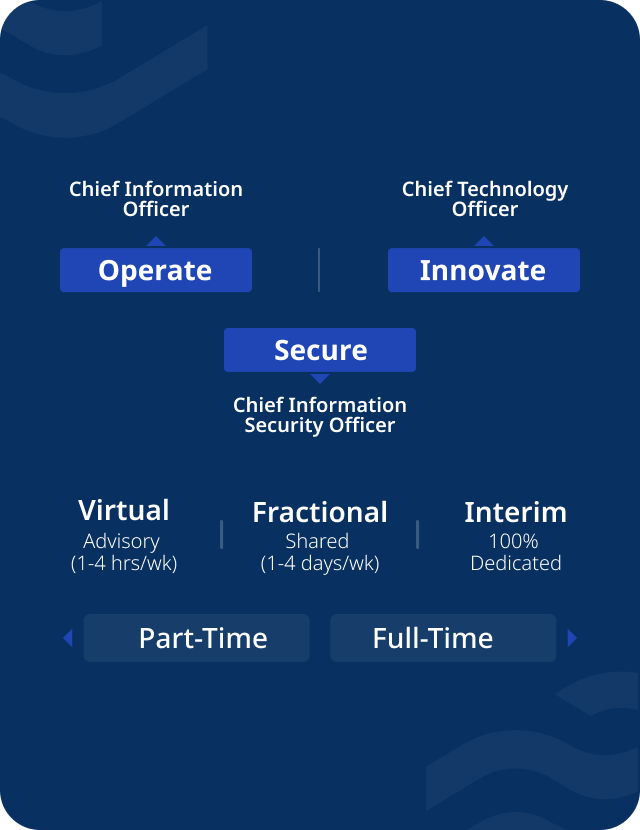
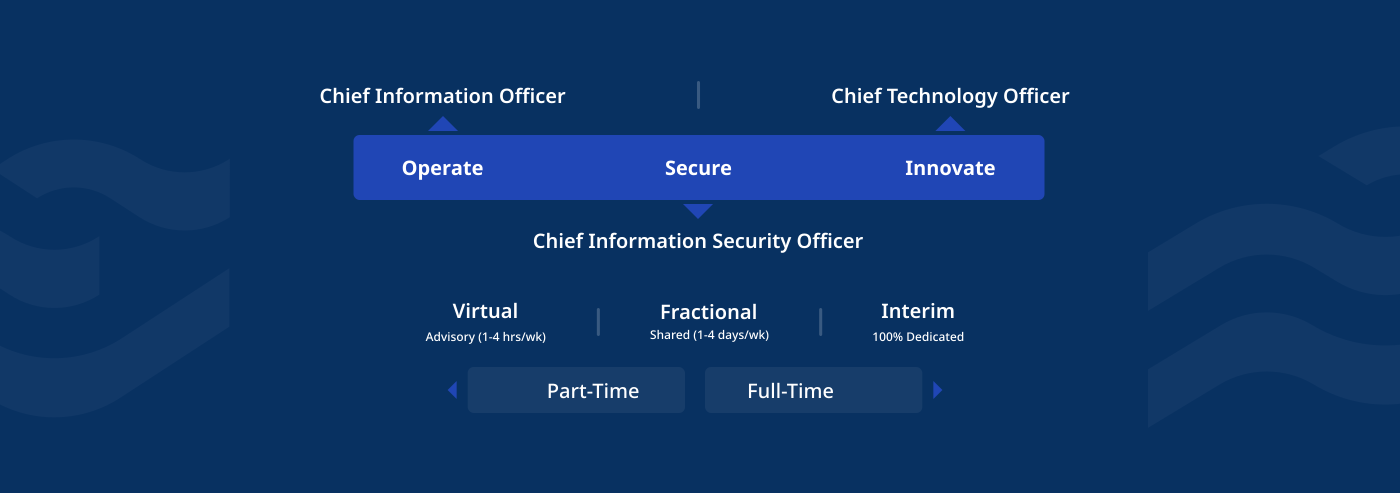
  • A vCIO is typically more advisory and light - offering a few hours per week, focused on strategy and guidance. A fractional CIO works part-time (e.g., 1 - 4 days per week), with real leadership responsibility and involvement in execution. 

  • An interim CIO is engaged full-time (5 days/week), typically to fill a sudden vacancy or manage a defined project or transition period. 

What are the cost and commitment implications of hiring a fractional CIO?

Engaging a fractional CIO typically requires a flexible contract - you pay only for the time and expertise you need, often without the full-time salary, benefits, or long-term commit­ment associated with a permanent hire. 

As needs evolve (e.g., increased IT complexity, multiple concurrent initiatives, regulatory demands), you can scale up the engagement - or transition to a full-time CIO if appropriate. 

What should I evaluate when choosing a fractional CIO provider like Fortium Partners?
  • Breadth and depth of leadership bench - ability to assign experienced CIOs with relevant domain experience and scalability for growth.

  • Flexibility of engagement models - virtual, fractional, interim - ensuring you only pay for what you need, when you need it.

  • Independence and vendor neutrality - enabling unbiased, business-first technology decisions.

  • Speed of deployment and readiness - ability to step in quickly to avoid leadership gaps or roadblocks.

  • Track record with companies similar to yours - ideally mid-market, PE-backed, growth-oriented firms undergoing transformation or scaling.

Have more questions?

Download our e-book, "The CEOs Guide to Hiring a CIO"

Four Reasons Your Business Needs a Fractional CIO

Rapid Growth

As an organization experiences rapid growth, reliance on manual procedures, entry-level IT support, and makeshift solutions from non-tech leaders become inadequate. This signals the immediate need for an experienced CIO.

Fill a Vacancy

The existing CIO has left through voluntary or involuntary separation, and the organization needs to fill the role quickly. 

Temporary Leave

The existing CIO is on temporary leave, and the organization needs to maintain momentum and provide leadership to the technology organization in its absence.

Not Enough Experience

Existing technology leadership, whether holding the CIO title or not, is too junior or overly technical in their focus. Or internal/external changes can expose gaps in an existing CIO's capabilities

Fortium also provides

avtar3

Chief Technology Officer (CTO)

Senior technology leader responsible for commercial software product development, reporting to the CEO or similar; usually in a technology organization

avtar2

Chief Information Security Officer (CISO)

Senior technology leader responsible for the overall security and compliance posture of an organization, generally, though not always, reporting to the CIO/CTO with CEO and Board autonomy, for technology and non-technology organizations