
 Back
Back

Listen to Blog
10:39
How a Multinational Consumer Goods Company Closed Its AI Accountability Gap in 6 months
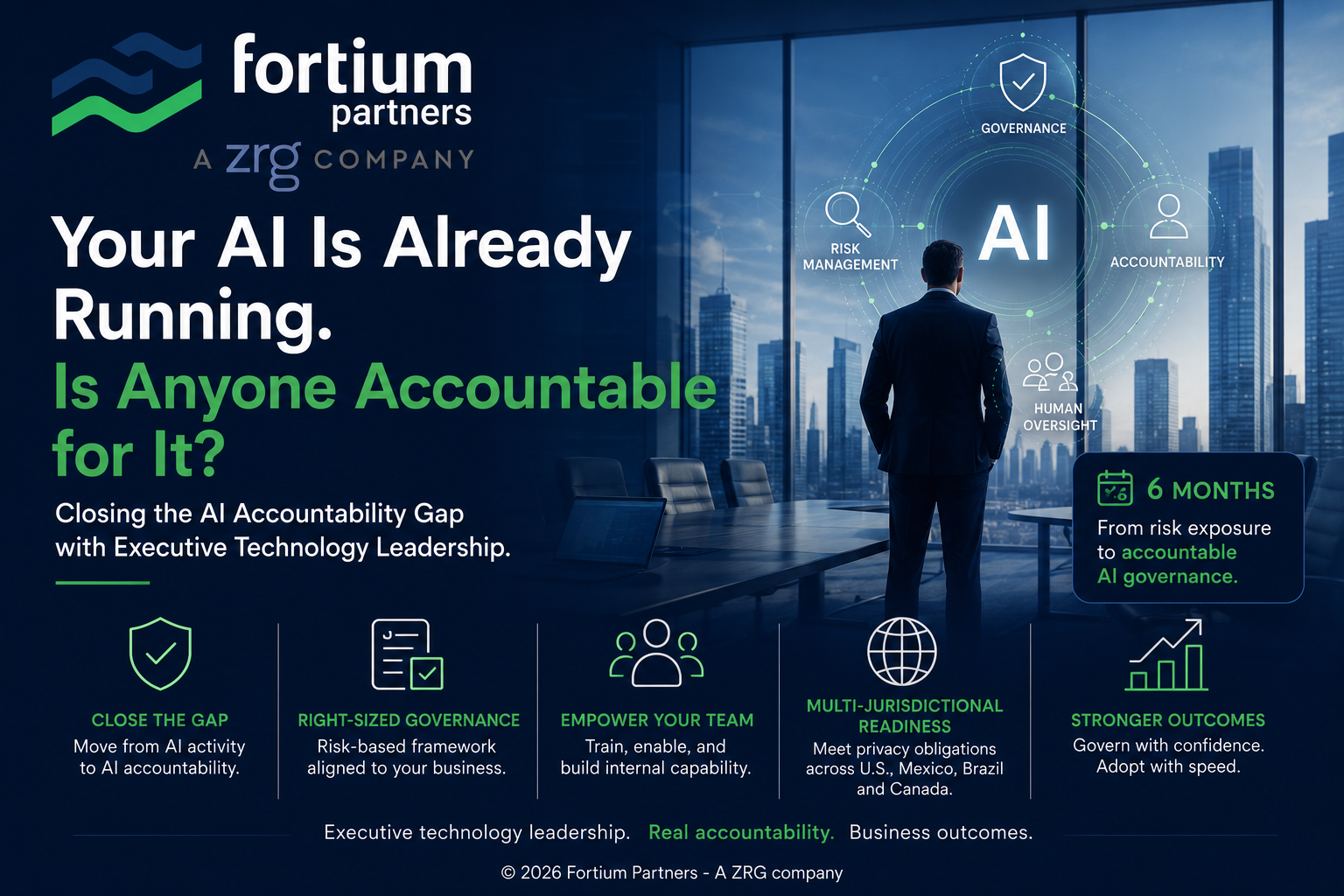
AI is already running inside your business. The question is whether anyone is accountable for it.
Not theoretica lly accountable. Not "the committee is aware of it" accountable. Operationally accountable - with a risk framework, an escalation path, a trained team, and a governance record for AI already in production.
For most executive teams, that gap between AI activity and AI accountability is now the real exposure. The risk is not that the business is moving too quickly. The risk is that no one has translated that movement into an operating model.
That was the situation facing an international consumer goods company with operations across the United States, Mexico, Brazil, and Canada. The organization had already taken visible steps toward AI adoption. It had chartered a 12-person AI Center of Excellence. It had deployed enterprise Microsoft Copilot and ChatGPT licenses. It had piloted its first AI agent.
But the AI activity had arrived before AI governance was set.
No formal risk assessment. No oversight design. No governance record for AI already running. No clear way to identify embedded AI features in third-party SaaS tools. And critically - a workforce with AI tools in hand and no training structure to turn those tools into productivity without creating unmanaged risk.
The AI Governance Committee Chair stated the priority plainly: close the governance gap before it becomes a liability.
The Moment AI Becomes an Executive Leadership Problem
AI governance often gets framed as a policy problem or a technology problem. In practice, it is a leadership problem first.
For CEOs, the issue is accountability: when AI produces an outcome the business didn't intend, who owns it? For CHROs, it is a people and adoption problem: employees are already using enterprise AI tools, but without structured training, the gap between tool access and productive, compliant use widens every week. For PE operating partners, this same dynamic - AI activity without AI accountability - appears across portfolios at scale. It is not one company's problem. It is the most common governance gap in mid-market companies actively scaling AI today.
A policy can define acceptable use. A committee can approve decisions. But someone still has to build the operating bridge between ambition and control. That bridge requires executive technology leadership.
This company did not need a theoretical AI strategy exercise. It needed someone who could enter a live environment, understand the risks already in motion, align executive stakeholders, and build a governance process the organization could actually use.
That is different from slowing AI down. The goal was not to make governance a brake. The goal was to make AI adoption governable enough to continue.
The Risks Were Already Inside the Business
The case is useful because the challenges were not exotic. They were familiar to almost any mid-market or multinational company beginning to scale AI.
Several conditions were in motion simultaneously: AI was in use before governance had been designed. Employees had access to enterprise AI tools but no structured training to use them effectively - unrealized value and unmanaged risk occupying the same space. Third-party SaaS platforms contained embedded AI features, often enabled by default, with no inventory of which were active.
The company also faced multi-jurisdictional privacy exposure across three regulatory regimes - California's CPRA, Mexico's FDPL, and Brazil's LGPD - each with distinct data handling obligations and, in some cases, direct executive liability for non-compliance. This was not a compliance team problem. It was a CEO and CHRO problem.
That combination creates a difficult executive equation. The company was exposed to risk, but it was also sitting on unrealized value. Locking down AI too aggressively would have wasted momentum. Letting AI continue without structure would have expanded liability. The answer had to be right-sized governance.
What Right-Sized AI Governance Looks Like in Practice
Fortium Partners, a ZRG company, deployed a Fractional Chief AI Officer for a six-month engagement. The work was grounded in ISO 42001 and the NIST AI Risk Management Framework - yet this was not a compliance exercise detached from the business. Every element was designed around the company's actual risk profile, its AI maturity, its operating structure, and a deliberate goal: when the engagement ended, the AI Center of Excellence needed to own and run the governance process independently.
The engagement began where it had to - with executive alignment. Before any policy was written, the governance operating model and RACI matrix were established, drawing clear lines between what the AI Governance Committee owned (policy and risk tolerance) and what the CoE owned (intake, assessment, and ongoing monitoring). Without that structural clarity, every governance decision downstream becomes a negotiation.
From there, the work built out the operational layer: a complete Enterprise AI Use Policy with a three-tier, risk-based classification model and a full working toolkit - intake form, AI impact assessment, model card, deployment authorization package, and incident response playbook. These were fillable, usable documents, not frameworks that live in a SharePoint folder. Simultaneously, an AI System Inventory and enhanced vendor security reviews surfaced embedded AI across third-party SaaS tools - answering the question the organization had not previously been able to answer: what AI is actually running in our environment?
The training component was designed with a specific constraint in mind: build capability, not dependency. Three hands-on CoE training sessions covered the tiering model, human-oversight requirements, and escalation triggers. The team left with a shared vocabulary and the judgment to apply the framework independently.
The final phase was the one that proved the model worked: guided application to a real use case.
The First Use Case Proved the Model
Governance is not operational because it exists in a document. It becomes operational when a team can use it to make better decisions on real work.
The first test was a distributor-facing Compensation Plan AI Agent. Initially, the use case carried the profile of a higher-risk initiative. Through the new governance process, the organization worked through the framework and reasoned it down from Tier 3 to "Tier 2 with controls" - a designation that allowed the business to move forward with appropriate guardrails rather than unnecessary delay.
That is the difference between performative governance and useful governance. A rigid model might have delayed a legitimate business initiative. An underdeveloped model might have waved it through without proper oversight. A right-sized model gave the team the analytical structure to make a defensible, documented decision - and move forward with confidence.
In other words, governance did not kill the AI initiative. Governance made the initiative safer to approve.
The Real Outcome Was Independence
In six months, the AI Center of Excellence moved from operating without guardrails to owning a turnkey governance process it could run on its own: a fully documented, standards-aligned framework ready for enterprise rollout; documentation to satisfy multi-jurisdictional privacy obligations across three regulatory regimes; a clear escalation path to the AI Governance Committee; a trained team working from a consistent vocabulary; and one real-world use case fully vetted from intake to authorization.
The Head of the AI Center of Excellence had spent months operating in a gap between AI ambition and accountability. After six months, the gap was closed - not because of a policy document, but because the team had the tools, structure, and judgment to govern AI decisions themselves.
"This is great - makes me feel very good about where we are."
That shift - from exposure to confidence - is the real marker of success. The organization did not become dependent on the Fractional CAIO. It became more capable because of the engagement.
The Accountability Gap Is a Leadership Test
AI governance is quickly becoming a test of technology leadership maturity. And most organizations are somewhere between experimentation and accountability - with AI activity but not AI ownership, with tools but not training, with risk but not a repeatable governance process.
This is where Fortium's Technology Leadership-as-a-Service® (TLaaS™) model becomes especially relevant. A company may not need a full-time CAIO yet. It may not be ready to create a permanent AI executive role. But when AI decisions begin affecting privacy, security, workforce productivity, vendor risk, customer trust, and executive oversight - the organization already needs AI leadership.
The Fortium model gives organizations access to experienced executive technology leadership before the full-time role exists and through every transition that follows. In this case, that meant a Fractional CAIO who could activate the AI governance function, build the operating model, transfer capability to the CoE, and leave the organization stronger than it was found. For PE operating partners evaluating governance posture across a portfolio, that model - specific, time-bound, designed for independence - is what separates AI leadership from AI activity.
The point is not to produce more AI activity. It is to make AI activity accountable, scalable, and useful.
Executive Action
If your organization has AI tools in use, AI pilots underway, or AI features embedded across third-party platforms, the question is not whether AI governance should exist.
The question is whether someone with executive technology judgment owns the path from experimentation to controlled adoption - and whether your organization could answer a board question about AI accountability today.
Schedule an AI governance leadership review with Fortium Partners, a ZRG company, to assess whether your organization has the leadership, governance model, and operating discipline to move from ungoverned AI activity to accountable enterprise adoption.
