 Back
Back

Listen to Partner Spotlight
9:43
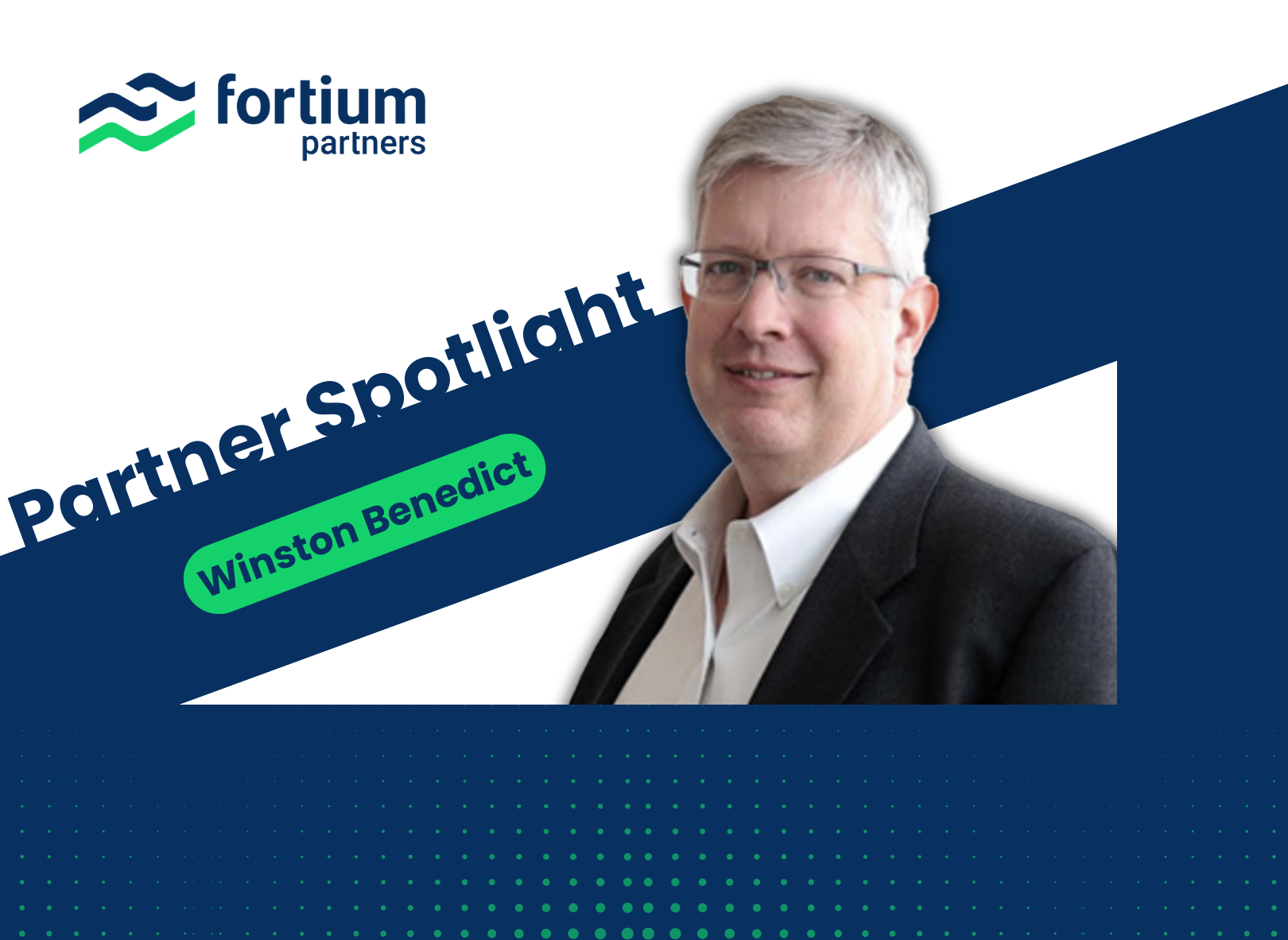
This interview outlines the professional profile of Winston Benedict, a strategic technology leader at Fortium Partners with extensive experience in driving technological transformation, scalable growth, and operational excellence across industries including media, advertising, automotive, and fintech. It highlights his expertise in M&A integration, data architecture, cybersecurity governance, and digital transformation. Furthermore, this cites his educational background, certifications, and his "servant leadership" style focused on empowering teams and delivering measurable business value.
At Fortium Partners, we pride ourselves on bringing seasoned technology leaders to the forefront of our clients' most pressing challenges and strategic opportunities. Today, I have the pleasure of sitting down with one of our distinguished Partners, Winston Benedict. With over 25 years of experience leading technology initiatives across diverse sectors - including: media, advertising, automotive, and financial services. Winston embodies the strategic vision and operational excellence our clients seek. His unique journey, from a robust consulting foundation at Accenture to serving as CIO at ACV Auctions and CTO at GSTV, has consistently focused on leveraging technology to drive business growth, profitability, and scalable innovation.
Burke Autrey: Winston, welcome. To start, you’ve held significant leadership roles, including CIO/CTO positions at major organizations like ACV Auctions, GSTV, and Dentsu Aegis Network. When you enter a new organization, particularly one facing rapid growth or needing a turnaround, what is your initial approach to aligning technology with business goals?
Winston Benedict: Thank you, Burke. It’s a pleasure to be here. My approach always starts with "Clarity First". Before diving into technical stacks or buying new tools, I focus on understanding the people, the organization, the business/board priorities, and the existing processes. Technology is often the easy part; the challenge lies in alignment of people, process and organizational priorities.
I look at where the constraints to scale are located. For example, when I joined ACV Auctions, the goal wasn't just to maintain operations but to identify and resolve IT constraints that were hindering scale while managing spend. I prioritize aligning IT capacity with the highest-value business outcomes. This often means sitting down with business leaders to understand their friction points - whether that's a sales team struggling with data visibility or a finance team bogged down by manual close processes. Once we have that alignment, we can apply the correct solutions (people, process and technology changes) to drive revenue and efficiency.
Burke Autrey: That focus on alignment is critical, especially for our Private Equity clients and Operating Partners who are looking for rapid value creation. You have a strong track record in M&A and integration - specifically at Dentsu Aegis Network where you integrated six acquisitions. What is the key to a successful technology integration that preserves value?
Winston Benedict: The key is rapid standardization without breaking the culture and processes that made the acquired company valuable in the first place. Again, this starts with clarity - clarity on what your operational platform looks like and the value adds of the acquired company. At Dentsu Aegis Network (ANZ), we integrated six acquisitions and 300 new employees. The technical challenge is often consolidating infrastructure - like doubling creative content storage capacity while keeping costs flat - but the real win comes from process integration. To achieve this, we had to first clearly define and standardize an operational platform (backoffice functions, IT infrastructure, CRM, etc) to bring the acquisitions onto..
For PE Operating Partners, I emphasize that technology integration must support the investment thesis. If the goal is efficiency, we need to look at shared services, infrastructure and enterprise architecture immediately. At Dentsu, I worked with the CFO, COO, CHRO to design an Enterprise Architecture that delivered a 15% one-time impact and 5% recurring savings in back-office operating expenses through standardization and automation. You have to move quickly to capture those synergies, but you also have to be a "servant leader," empowering the new teams so they don't feel conquered, but rather supported by better tools and clearer processes.
Burke Autrey: Let’s pivot to the CHRO perspective. You describe yourself as a "servant leader" and have mentored staff who have gone on to become C-level executives themselves. How do you build high-performing, resilient technology teams, especially during times of disruption?
Winston Benedict: Talent retention and development are metrics I take very seriously. During my time at Dentsu Aegis Network, despite significant industry disruptions, we maintained a staff turnover rate of under 5% over three years. That doesn't happen by accident.
I believe in granting autonomy and providing clarity of purpose. I tell my teams that I want them to own the outcomes, and I celebrate the learning that comes from failure just as much as the success. When you remove the fear of failure, you unlock innovation. As a servant leader, my role then is to enable them to achieve those outcomes and purpose by working with them to overcome the barriers and constraints they face. At GSTV, for instance, we grew the team and implemented Agile and Product Management practices. This shifted the culture from just "taking orders" to actively partnering with the business to deliver value.
For CHROs, my message is that culture is a technology accelerator. If you trust your people and give them clear guardrails - like the "no surprises" rule I stick to - they will execute at a higher level. I’ve mentored staff at Ally, Dentsu Aegis Network and Accenture who are now C-suite executives because I focused on their growth, not just their output.
Burke Autrey: Innovation is a buzzword we hear constantly, but you’ve actually operationalized it. You introduced operational AI adoption strategies and modernized ad-serving platforms at GSTV. How do you balance the need for innovation with the stability required by the CIO office?
Winston Benedict: It’s about "safe adoption" and governance. At ACV Auctions, we introduced an operational AI adoption strategy that included governance and usage policies. This allowed users to experiment and apply AI for back-office efficiency, but it was done within a framework that ensured data protection and cybersecurity.
At GSTV, we partnered with Vistar Media to transition to a programmatic ad-serving system. This was a major innovation that allowed us to unlock unsold supply and double our programmatic business year-over-year. However, we didn't just flip a switch. We ensured the underlying data architecture - built on Snowflake - was solid first.
Innovation without stability is chaos. I leverage pilots to test concepts and frameworks like NIST for cybersecurity to ensure we are resilient. This allows us to be aggressive on the front end - like launching new data products - because the back end is secure and compliant. It’s about managing risk, not avoiding it.
Burke Autrey: Finally, Winston, you have a diverse background - from aviation to serving on the New Enterprise Forum. How do these outside interests influence your work as a technology leader?
Winston Benedict: I’m a licensed private pilot and an aviation geek - I even volunteer as a docent at the Michigan Flight Museum. Aviation teaches you about checklists, discipline, and situational awareness. You can't "wing it" at 5,000 feet, and you shouldn't wing it with enterprise security or architecture. Additionally, you have to always stay current and constantly sharpen your skills. Like technology, failure to stay current with your skills means you will increase your risk of bad things happening.
My work with the New Enterprise Forum and as a startup advisor helps me stay connected to the bleeding edge of technology and entrepreneurship. It keeps me grounded in the "art of the possible." Whether I’m coaching a founder or advising a Fortune 500 executive, the core principle remains the same: use technology to solve human and business problems. It’s about clarity, scaling with intent, and delivering value that lasts.
Burke Autrey: Winston, thank you for sharing your insights. Your ability to blend high-level strategy with hands-on execution makes you a tremendous asset to the Fortium team and our clients.
Winston Benedict: Thank you, Burke. I look forward to helping our clients navigate their next phase of growth.
Are you a CEO or C-level executive looking to drive growth, navigate complex transformations, or build a more agile and innovative technology organization? Fortium Partners brings proven technology leaders like Winston Benedict to your executive team, offering advisory, fractional, and interim CIO, CTO, and CISO services tailored to your unique needs.
Contact us today to discover how our Technology Leadership-as-a-Service® model can help you unlock your strategic advantage. OR…
Get your copy of The CEO’s Guide to Hiring Technology Leaders today and take the first step toward building a technology leadership team that will deliver exceptional results for your business.
