
 Back
Back

Listen to Blog
13:51
Technology decisions are now executive-level. The question is whether your leadership structure has caught up.
By the time most CEOs recognize they need a Chief Information Officer, the gap has been open for months - sometimes years.
CEOs who do not have an experienced Technology Leader face many challenges: AI decisions are landing on the CEO's desk without a trusted technology voice in the room. Systems have stopped scaling. Vendor contracts are multiplying without accountability. Cybersecurity is now a board-level conversation. And what started as IT has quietly become enterprise strategy.
This is the Technology Leadership Gap. And a growing number of CEOs, CHROs, and private equity operating partners are not waiting for the perfect full-time hire to close it. They are accessing executive technology leadership through a model that is faster, more flexible, and better matched to how businesses actually grow.
The model is called the Fractional CIO. And it is not what most executives think it is.
What is a Fractional CIO?
A Fractional CIO is a proven, executive-level Chief Information Officer who works with a company on a part-time, retained, or engagement basis - bringing the same strategic judgment, C-suite credibility, and board-level technology leadership that a full-time CIO would provide, without the full-time hire.
The term "fractional" describes the engagement structure. It does not describe the executive. A Fractional CIO is still a CIO. They lead technology strategy, manage vendor relationships, translate risk into business language, guide digital and AI transformation, and hold a real accountability seat at the executive table. The hours-per-week differ. The leadership expertise does not.
This distinction matters. Too many organizations are still letting hours-per-week define whether they have executive technology leadership. The right question is not how many hours a leader works. It is whether technology decisions are being made with executive presence, strategic accountability, and the credibility to lead at the C-suite.
The Two Gaps That Drive The Need
Understanding when a Fractional CIO makes sense requires naming the two distinct problems the model solves.
The Credibility Gap
The Credibility Gap exists when technology decisions have become executive-level - but the company does not yet have an executive-level technology leader in place with the C-suite presence and gravitas to drive the agenda.
This is the gap most growth-stage companies live inside longer than they should. Technology reports to the CEO, CFO, or COO. Vendors multiply. AI, ERP, cybersecurity, and data decisions are escalating. The board is starting to ask harder questions - and no one in the building is fully equipped to answer them at the executive level.
The Credibility Gap is not simply about technical skill. An IT director can be highly capable and still lack the executive presence to lead at the board level, challenge a vendor contract with authority, or translate technology risk into business strategy in a language the C-suite acts on. That gap between technical competence and executive credibility is where technology decisions get made poorly - or deferred until the cost is higher.
The Continuity Gap
The Continuity Gap exists when technology leadership was in place - and then departed, transitioned, or became at risk.
The cost of this gap is not just the open seat. It is the loss of strategic momentum, institutional knowledge, and organizational confidence. The average full-time CIO search takes six to nine months. For most mid-market companies, that is a long time to leave technology leadership on autopilot - particularly as cyber threats, AI adoption, and systems complexity continue to accelerate.
A Fractional or Interim CIO from a firm with a deep national bench does not just fill the seat. It maintains the function. Technology leadership continues. The board does not have to wait for a search to make decisions.
What The Research Says
The data makes the case for closing both gaps faster - not slower.
Gartner research reveals that only 48% of digital initiatives meet or exceed their business outcome targets. Among organizations with what Gartner calls "Digital Vanguard" leadership - CIOs with the executive mandate, credibility, and co-ownership model to drive technology outcomes - that success rate rises to 71%. The difference is not the technology. It is the quality of leadership behind it.
McKinsey's work on private equity value creation identifies operational and technology leadership as among the highest-leverage interventions available to portfolio companies during a hold period. As capital costs rise and exit multiples compress, the margin for underinvestment in executive technology leadership is shrinking.
Bain & Company's 2026 Global Private Equity Report frames today's environment clearly: modern deals demand faster EBITDA growth, with sharper operational value creation and a clearer strategic edge. Technology leadership that activates early in the hold period - rather than reacting to problems - is increasingly the differentiator between funds that deliver and those that do not.
PwC's Global CEO Survey consistently ranks technology-driven disruption among the top three business risks CEOs identify - and yet a significant portion of mid-market companies have no dedicated executive assigned to manage that risk. The gap between technology as a board-level priority and technology as a board-level function is where value is lost.
Deloitte's research on organizational agility finds that companies with dedicated technology leadership at the executive level make faster, better-informed decisions on AI, digital transformation, and systems investment - and absorb disruption more effectively than those where technology accountability is distributed without a clear owner.
The conclusion across every major research body is consistent: executive technology leadership is a business performance driver. The question is how you access it - and when.
WHO NEEDS A FRACTIONAL CIO?
For CEOs
If technology decisions are now too strategic for you to absorb alongside every other business priority - but the timing, budget, or organizational maturity does not yet support a full-time CIO - you have a Credibility Gap. If your technology executive just left and a full search will take months the business cannot afford, you have a Continuity Gap.
Both gaps have a cost. Neither is solved by waiting.
"You may not need a full-time CIO. But someone needs to be thinking - and leading like one."
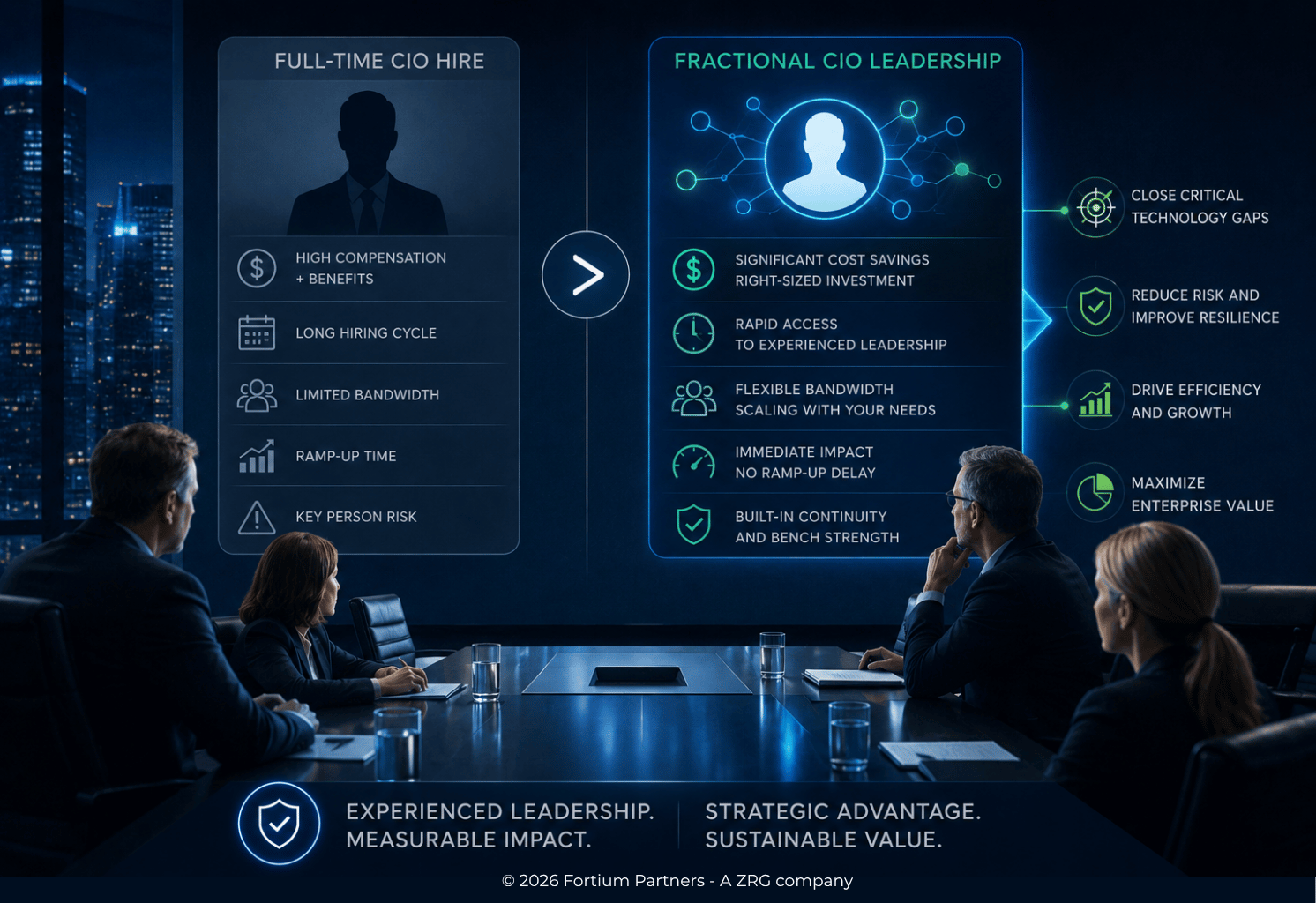
The Fractional CIO model gives CEOs executive technology leadership with real C-suite credibility - deployed before a full-time hire makes sense, and sustained through every transition that follows. No vendor agenda. No search delay. No single-person dependency. No wrong hire to absorb.
For CHROs
The CHRO often finds themselves in the most difficult position: caught between an urgent business need and a search process that cannot move at the speed the company requires. An interim solution can close that gap.
Org design may not yet support a full-time hire. Budget has not been approved. The talent market for seasoned technology executives is competitive. Or the CIO just departed and the CHRO is managing a search on a timeline the business cannot afford to honor.
The Fractional CIO model gives CHROs a credible path forward: activate executive technology leadership before the permanent role is ready, and define what the right permanent role actually looks like - from the inside, with a leader who understands the company's real technology maturity and strategic needs.
"Fortium lets you solve the leadership gap before you create the job description - and keep it solved when the role turns over."
The technology leader who bridges the gap also becomes the most informed advisor on what the permanent hire should look like. That reduces the risk of the wrong hire and improves the quality of the search.
For PE Operating Partners
Technology leadership is one of the highest-leverage value creation levers in private equity - and one of the most inconsistently deployed across portfolio companies.
Some portfolio companies arrive with a mature CIO. Others have IT reporting to the CFO. Most fall somewhere in between, with a mix of technical talent and strategic technology gaps that compound over the hold period as AI, cybersecurity, ERP, and data demands escalate.
The challenge for operating partners is not identifying the gap. It is having a repeatable model to close it - at the right maturity stage, for the right cost, without a six-month search delay or a single-person dependency risk.
A Fractional CIO from a firm with national bench depth gives PE operating partners exactly that: a deployable, scalable model for activating CIO, CTO, or CISO leadership across the portfolio before technology gaps become value-creation constraints - or exit risks.
"Fortium gives PE operating partners a repeatable model: activate CIO, CTO, or CISO leadership before gaps become exits."
The Access Model: A Strategic Shift In How Executive Leadership Works
The traditional model for executive leadership is ownership- a full-time hire. Own the role. But ownership carries the full risk: if the hire is wrong, you absorb the sunk cost. If the executive departs, you restart the search. If the business outgrows the role - or the role outgrows the business - there is no recourse.
The Fractional CIO model is built on access. Access the right executive for the right stage, with an institutional bench behind them if circumstances change. The role is defined by accountability and business outcomes - not by how many days per week the leader is on-site.
This shift mirrors a broader pattern across how leading organizations are consuming senior expertise. The question is no longer "can we justify owning this executive capacity?" It is "can we access the right capacity at the right moment - and maintain it through every transition?" This approach also paves the way for a full-time hire - if and when one is needed.
When Fortium deploys a Fractional CIO, the client accesses not just one leader but the institutional function behind them: knowledge continuity, peer bench depth, and a national roster of proven CIO, CTO, and CISO partners who can be matched to the company's industry, stage, and gap type.
What To Look For in a Fractional CIO Partner
The market for technology leadership services has expanded - and not all providers are built the same.
Independent practitioners offer one experienced person with no institutional backup. If the fit is wrong, you absorb the cost and restart.
Talent marketplaces shift vetting responsibility to the buyer and substitute algorithmic matching for institutional accountability.
MSPs and MSSPs often position "vCIO" advisory services tied to their own vendor and service agendas - which creates a conflict the client may not see.
Consulting firms may use technology leadership as an entry point for implementation projects they are also positioned to deliver.
Multi-role interim executive firms cover many C-suite functions without the depth to differentiate across technology strategy, cybersecurity, AI, transformation, and operating models.
ZRG and Fortium together offer a comprehensive solution- fractional/interim CIOs, CTOs, CISOs (Fortium() as well as the expertise to hire a full-time leader thereafter (ZRG). The differentiators that matter most when evaluating a Fractional CIO provider:
-
Executive presence and C-suite credibility - not just technical capability, but the gravitas to lead at the board level and translate risk into business language
-
National bench depth - so that if the initial fit is not right, you can rotate to a better match without restarting a search or absorbing full replacement cost
-
Pure-play technology specialization - a firm built exclusively around CIO, CTO, and CISO leadership brings depth that generalist firms cannot replicate
-
No vendor agenda - technology leadership advice should serve your business agenda, not a downstream service sale
-
Transparent, named roster - you should be able to see and verify the caliber of leadership before you commit
The Bottom Line
Your company may not need a full-time CIO yet. Or it just lost one. Either way, it already needs executive technology leadership - with the credibility to lead and the continuity to last.
The Fractional CIO is not a compromise. It is the model that closes the Technology Leadership Gap without the cost, delay, and risk of a premature permanent hire. And for CEOs, CHROs, and PE operating partners managing complex organizations through accelerating change, that model is increasingly not the backup plan.
Fortium Partners is the one and only firm that closes both the Technology Leadership Credibility Gap and the Technology Leadership Continuity Gap - turning executive technology leadership from a missing or at-risk role into an on-demand business capability. With 180+ named CIO, CTO, and CISO partners across the U.S. and Canada, Fortium activates the right executive technology leader for your business stage - before the role exists, through every transition, and for as long as the business needs it. Ready to measure your technology leadership confidence?
Fortium's Technology Confidence Index gives CEOs, CHROs, and PE operating partners a fast, structured way to assess whether their organization has the technology leadership in place to execute on its biggest business priorities - or whether a gap is quietly compounding.
Take the Technology Confidence Index here (in less than 3 minutes) and find out where your organization stands and receive actionable recommendations on how to close the gaps.
