
 Back
Back


The AI question has changed. Twelve months ago, executive teams were asking what to pilot. Today, the harder question is: how do we deploy AI at scale, responsibly, and in a way that actually moves the business?
That shift is the premise behind ATLAS’ inaugural Fireside Chat, a candid, on-the-record conversation hosted by Graham Peelle and Ash Seddeek of The ATLAS Leader Program (theatlasleaderprogram.com), a custom-built co-leadership engine for the cross-functional teams driving AI inside the enterprise. Joining them were two of Fortium’s most sought-after enterprise AI practitioners: Patricia Remacle, Fractional Chief AI and Product Officer, and Christoph Egel, Partner & CIO at Fortium Partners.
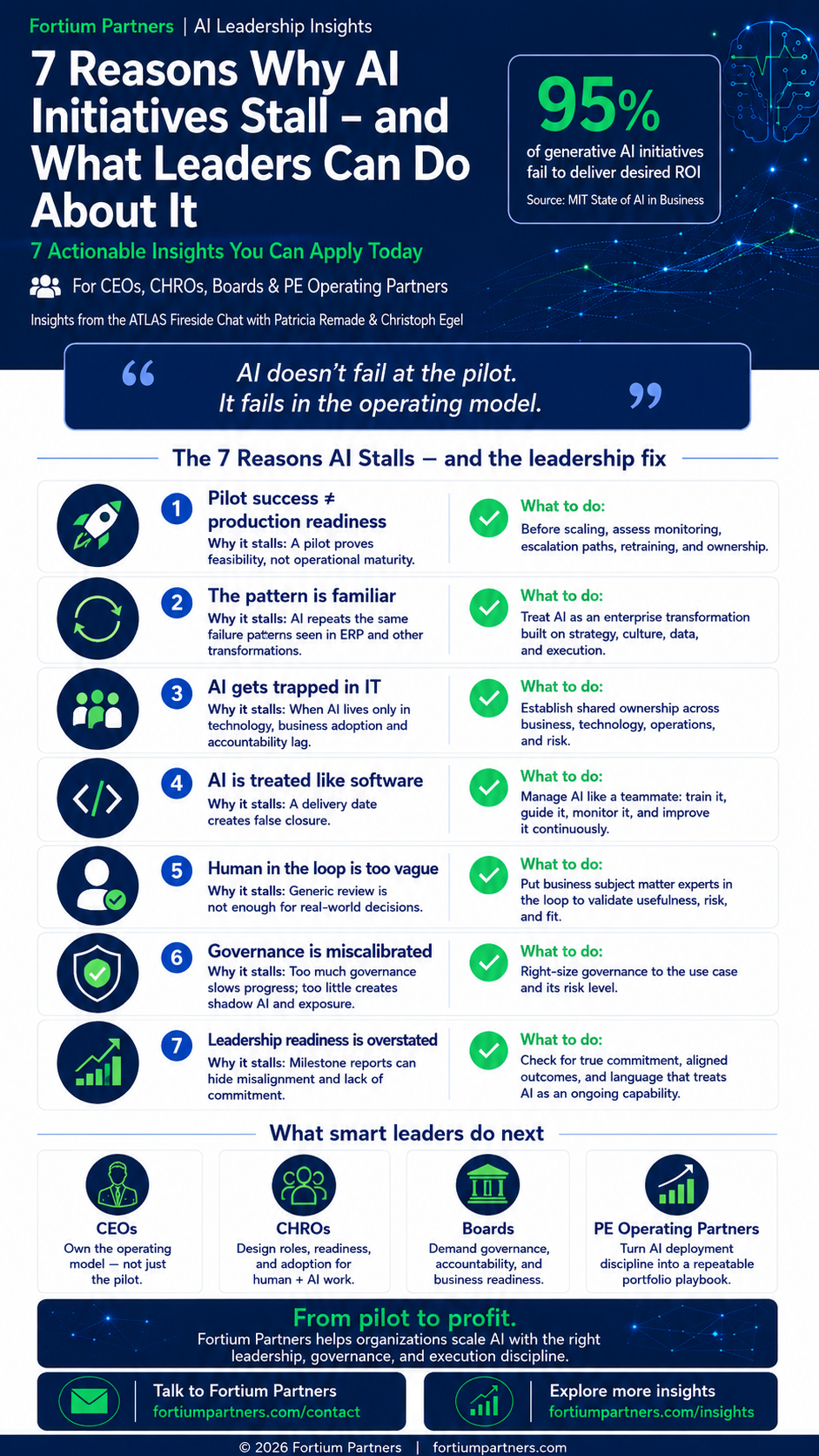
What emerged was not a technology briefing. It was a leadership diagnosis. Below are seven of the most consequential insights from that conversation, structured for the CEOs, CHROs, boards of directors, and PE operating partners who are accountable for what happens after the pilot ends.
95%
of generative AI initiatives fail to deliver on their desired ROI, according to MIT’s State of AI in Business study:
The failure pattern is not new. Three decades ago, we saw the same dynamic with ERP.
1. The pilot is not the finish line
AI pilots create real momentum. A team automates a workflow, accelerates a customer interaction, or unlocks a productivity gain in a controlled environment. That success is genuine. It is also incomplete.
Production AI is a different discipline. Once AI enters real operations, the organization must manage performance drift, escalation pathways, incident response, model retraining, human review cycles, and lifecycle accountability. The pilot validates technical feasibility. It does not validate operational maturity.
For CEOs and PE operating partners, the relevant question after a successful pilot is not “can it work?” It is “can our organization govern it when conditions change, outcomes become unpredictable, and the model needs to evolve?” That answer requires an honest assessment of operating model readiness, not just technical proof of concept.
2. The failure pattern is not new - only the technology is
MIT’s State of AI in Business study reports that roughly 95% of generative AI initiatives fail to deliver on their desired ROI. For any board that has reviewed enterprise transformation initiatives over the past three decades, that number should feel familiar.
ERP transformation produced the same pattern. The technology was different. The failure mode was not. Organizations that succeed with AI are not the ones with the most pilots or the most sophisticated models. They are the ones that apply the same four fundamentals that have defined every successful enterprise transformation: a strategy framework aligned across all business functions, a culture prepared for sustained adoption, technology and data assets that integrate and meet quality standards, and execution discipline across the entire lifecycle, including everything that happens after go-live.
CHROs in particular should recognize the cultural dimension here. AI adoption fails without workforce readiness, engagement, and continued listening. Building an environment that allows solutions to actually be used is as important as building the solution itself.
3. Treating AI as an IT project is a governance error
One of the most common and most costly mistakes organizations make is assigning AI accountability to technology leadership alone. AI depends on technical infrastructure, data pipelines, cybersecurity controls, and model architecture. Its success, however, depends just as heavily on business ownership, process redesign, workforce adoption, and risk accountability.
For boards and PE operating partners evaluating portfolio company AI programs, this is a structural question. If the AI initiative lives in the technology organization without clear co-ownership from business leadership, the risk of stalling, scaling without governance, or producing outputs the business cannot actually use is materially higher.
“On a recent customer-facing initiative, we delivered on time, below budget, exceeded our best-case ROI, and were named Best Supplier of the Year within 18 months. That outcome wasn’t an IT win. It was a co-owned, co-delivered win.”
— Christoph Egel, Partner & CIO, Fortium Partners
4. Think of AI as a teammate, not a software project
The leaders who consistently move AI from pilot to production stop describing it as a project with a delivery date and a handoff. They describe it as a capability being woven into the organization, one that requires ongoing context, feedback, and attention.
A useful frame from the ATLAS Fireside Chat: approach an AI agent the way you would approach hiring. You recruit for skill. You train. You set guardrails. You monitor performance. You intervene when behavior moves outside expected boundaries. And you continue that cycle, because the technology, like any team member, keeps evolving.
For CEOs communicating AI strategy to boards or investors, this language matters. Organizations that describe AI as a software delivery project signal a governance posture that underestimates post-launch complexity. Organizations that describe it as a capability under active stewardship signal the maturity boards and PE investors are looking for.
“AI is non-deterministic. It will say things very confidently and very definitively that may be very wrong. That is why a human-in-the-loop review is not optional.”
— Patricia Remacle, Fractional CAIO, Fortium Partners
5. Human in the loop must mean business in the loop
Many organizations use “human in the loop” as a compliance statement rather than a governance design. Any human review is treated as sufficient. It is not.
For AI to be trusted in real operations, review must involve the people who understand the business context. Business subject matter experts know what is useful, what is misleading, what creates compliance exposure, and what is operationally impractical. IT teams can validate systems. Data teams can monitor performance. Security teams can assess exposure. Without business leaders and subject matter experts actively participating in governance, the model loses its compass and the organization loses its first line of defense against drift.
For CHROs, this has direct workforce implications. Human-in-the-loop governance requires deliberate role design, not just policy acknowledgment. Organizations need to define which employees are accountable for AI output review, how that accountability integrates with existing job responsibilities, and how performance expectations evolve as AI takes on more of the cognitive load.
6. Right-sized governance is what keeps AI moving
Governance is frequently described as the thing that slows AI innovation. The more precise observation from the ATLAS Fireside Chat is that badly calibrated governance slows AI in both directions. Too heavy, and business teams route around it, creating shadow AI. Too weak, and the organization accumulates unreliable outputs, compliance exposure, and reputational risk without a detection mechanism.
Right-sized governance is calibrated to the risk profile of each use case. An individual using a general AI assistant to draft internal communications needs an acceptable-use policy. An agentic system automating a revenue-affecting workflow needs human-in-the-loop review design, monitoring, incident response protocols, and a kill switch, all designed in at the start rather than bolted on after launch.
For boards reviewing AI governance frameworks, the benchmark question is whether the governance structure creates clarity or bureaucracy. Clarity enables faster, more confident AI adoption by giving business teams an unambiguous picture of what responsible adoption looks like. Bureaucracy creates the shadow AI problem the governance was supposed to prevent.
7. Two readiness signals matter more than any milestone report
Before funding another AI initiative, the ATLAS Fireside Chat offered two signals worth applying directly to your own organization.

Christoph’s signal
Are all affected parties fully committed to doing whatever the initiative requires? Do they understand what that commitment actually involves? Do they agree on the outcome? If any of those three answers is no, the initiative is already at risk.
Patricia’s signal
Listen to how your leaders talk about AI. If they describe it as a software project with a delivery date and a handoff, the organization is not ready for scaled deployment. Leaders who succeed describe AI as a capability being woven into the business, one that needs ongoing context, feedback, and investment.
“The conversation has shifted from “what are our use cases?” to “how do we now deploy this at scale, and responsibly?””
— Patricia Remacle, Fractional CAIO, Fortium Partners
For PE operating partners assessing portfolio company AI maturity, these two signals are faster and more predictive than any milestone dashboard. Breadth of buy-in and leadership vocabulary reveal operating model readiness before the first production deployment ever surfaces an issue.
The Fortium Perspective
AI should not be treated as a technology project. It should be treated as an enterprise leadership initiative.
For CEOs, boards, and PE operating partners, the relevant question is not whether the organization has AI activity. The question is whether it has the technology leadership credibility and continuity as well as the governance model, data readiness, and operating discipline required to make AI work beyond the pilot.
Technology Leadership as a Service® (TLaaS™) gives organizations access to experienced Technology Leaders (CIO, CTO, CISO, and CAIO) during the moments when AI ambition must become governed execution. Fortium helps align strategy, governance, data readiness, risk oversight, and business adoption so AI can move from experimentation to enterprise value.
The goal is not more AI activity. The goal is AI the business can trust, govern, scale, and measure.
Connect with a Fortium executive partner through fortiumpartners.com/contact
This post summarizes insights from the ATLAS Fireside Chat with Patricia Remacle and Christoph Egel of Fortium Partners, hosted by Graham Peelle and Ash Seddeek of The ATLAS Leader Program (theatlasleaderprogram.com). You can view the full podcast video HERE.
