
 Back


|
Executive Highlights
|
Your company may be funding an AI initiative across operations, product, security, and finance. The pilot works. Then production decisions begin. Who approves the risk, owns the data, and decides whether the economics justify scaling? Progress slows because every leader owns part of the answer and no one owns the overall outcome.
This is an accountability architecture problem.
Thoughtworks' 2026 survey of 3,200 CIOs found that nine in ten leaders believe central IT would still be held accountable for security or compliance failures caused by AI tools purchased independently by business units. Responsibility has spread, but accountability has not moved with it.
Why a New Title May Not Fix the Gap
A Chief AI Officer can signal commitment. Yet, without a mandate, budget authority, and decision rights across the C-suite, the role can add another boundary instead of resolving existing ones.
In Grant Thornton's 2026 AI Impact Survey of 950 senior leaders, 78% lacked strong confidence that their organization could pass an independent AI governance audit within 90 days. Three in four boards had approved major AI investments, yet 48% had not set governance expectations.
The board-level question is not, “Do we need a CAIO?” It is, “Which executive leader has authority over every material AI decision?”
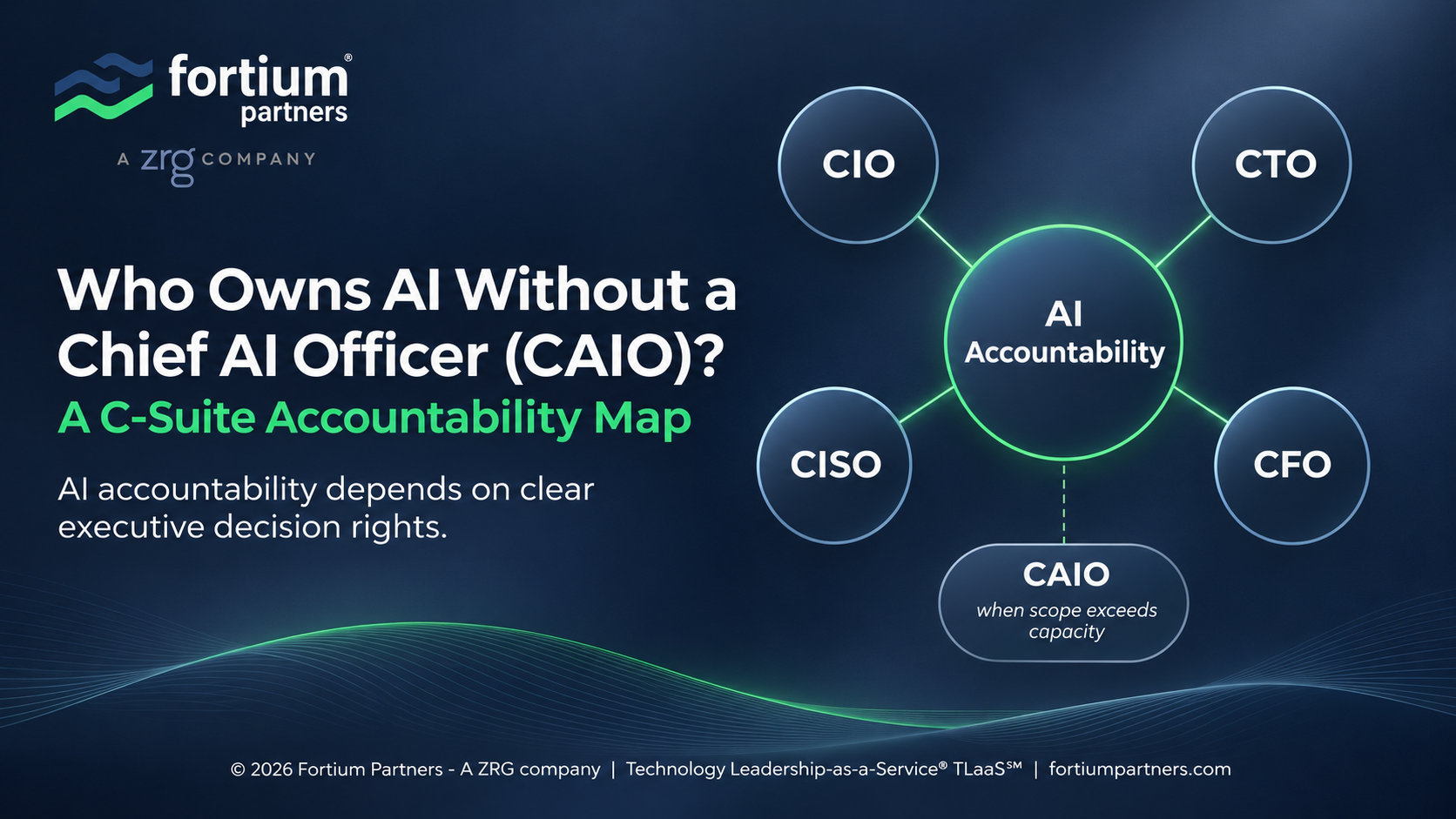
The AI Leadership Architecture Map
|
Executive Role |
Primary AI accountability |
|
CIO |
Enterprise strategy, data governance, vendors, and operating integration |
|
CTO |
Product, engineering, architecture, and AI-enabled customer experience |
|
CISO |
Security, identity, third-party risk, incident response, and controls |
|
CFO |
Business-case validation, cost transparency, value measurement, and investment discipline |
|
CAIO or equivalent |
Cross-functional strategy when scope, risk, and complexity exceed existing capacity |
The map is a decision aid, not a universal org chart. Each domain needs a named owner with authority and capacity. One executive should own the integrated AI outcomes and resolve cross-functional tradeoffs.
Match the Leadership Model to the Business Moment (Full-time, Interim, or Fractional)
Your organization can expand an existing mandate when AI is concentrated and the CIO or CTO has sufficient authority and bandwidth.
Alternatively, you can add fractional or interim leadership when the mandate is clear but capacity is constrained. This model can establish governance and stabilize decisions without the high costs of immediately adding permanent overhead. The Fractional CIO: Why Access Beats the Full-Time Hire explains why engagement structure does not diminish executive accountability.
When do you need a full-time executive? You can appoint a dedicated AI executive when production use cases, regulatory exposure, or AI-enabled products create a full-time mandate. As Beyond the CAIO argues, the title should follow the accountability requirement.
What the Board Should Expect in 90 Days
If your organization has not mapped AI accountability, here’s a systematic way forward that will allow you to take action now. Your team needs:
-
An accountability map naming the business and executive owner for every material AI system.
-
A risk classification defining risk tiers, human review, and escalation requirements.
-
A governance baseline covering intake, approval, monitoring, incident response, and evidence.
-
A value framework connecting each initiative to measurable operating or financial outcomes.
-
A leadership model decision confirming whether existing leaders have adequate authority and capacity.
Grant Thornton found that fully integrated AI organizations were nearly four times more likely than those still piloting to report AI-driven revenue growth, 58% versus 15%. This is an association, not proof that governance caused the difference, but it supports building accountability while you scale.
Fortium helps CEOs, boards, and PE operating partners design that architecture through Technology Leadership-as-a-Service® (TLaaS℠). That may mean clarifying decision rights, adding credible fractional or interim leadership backed by a broader executive bench, or preparing for a permanent hire.
AI needs an owner with authority, capacity, and measurable accountability.
Let Fortium accelerate the process with you.
Take the Technology Confidence Index or contact Fortium to identify accountability gaps and determine which leadership model fits the business moment.
Frequently Asked Questions
One existing executive should own the integrated outcome, while CIO, CTO, CISO, CFO, and business leaders retain clearly defined domain decisions. The lead owner depends on whether AI is primarily an enterprise, product, risk, or transformation mandate.
A dedicated executive becomes appropriate when AI use cases, regulatory exposure, product dependence, and cross-functional decisions exceed the authority or capacity of existing leaders or the capacity of a fractional executive; another option is to leverage an interim executive before making any full-time hire. It is a scope-and-complexity decision, not a prestige decision.
It can delay decisions, duplicate spending, obscure risk, and make outcomes difficult to measure. Grant Thornton found a 58% versus 15% reported revenue-growth gap between fully integrated and piloting organizations, an association that underscores the value of disciplined scaling.
Yes. A fractional or interim executive can establish decision rights, risk reporting, value measures, and escalation paths while the company determines whether it needs a permanent role. Fortium is the #1 provider of Technology Leadership in the USA.
The board should receive an accountability map, AI risk classification, governance baseline, value measurement framework, and a documented decision on the appropriate leadership model.
