
 Back
Back

|
Executive Highlights
|
A portfolio company's management team presents its AI update. The pilot is live. Employees are using it. The next funding request is ready. Then the operating partner asks three questions:
-
What business metric changed?
-
Who owns the result?
-
What evidence would a buyer see?
If the answers are incomplete, the initiative has not necessarily failed. It has entered the AI proof gap - the distance between reported AI activity and evidence that the activity created durable business value.
That gap is already shaping private equity decision-making. In a 2026 survey of 100 senior PE investors, BCG found that 76% cited unclear ROI as a blocker to digital-to-AI transformation. Similarly, the PwC 29th Annual CEO Survey 2026 revealed that 56% of CEOs report no financial benefit from their AI investments so far, while Deloitte’s Global Technology Leadership Study 2026 found that 42% of technology leaders report low or no ROI.
The problem is not a shortage of pilots. It is a shortage of proof that can survive an investment committee, lender review, or buyer diligence process. That gap is already shaping private equity decision-making.
AI activity is not AI value
AI activity is easy to count: pilots launched, licenses assigned, workflows identified, employees trained, and dollars approved. These indicators show that the company is moving, but they do not show whether revenue, margin, retention, operating cost, decision speed, or enterprise resilience changed.
AI value is a measured business result connected to a defined use case. Defensible AI value goes further. It shows the baseline, measurement method, accountable owner, operating dependencies, controlled risks, and repeatability of the outcome.
The opportunity is real. BCG reported that PE-backed companies systematically building advanced AI capabilities across functions achieved nearly twice the return on invested capital of companies that did not. However, according to Accenture’s Pulse of Change 2026, only 23% of companies report sustained value creation from AI over time. That finding strengthens the case for disciplined investment, but it also raises the standard: the value creation plan needs more than an AI narrative.
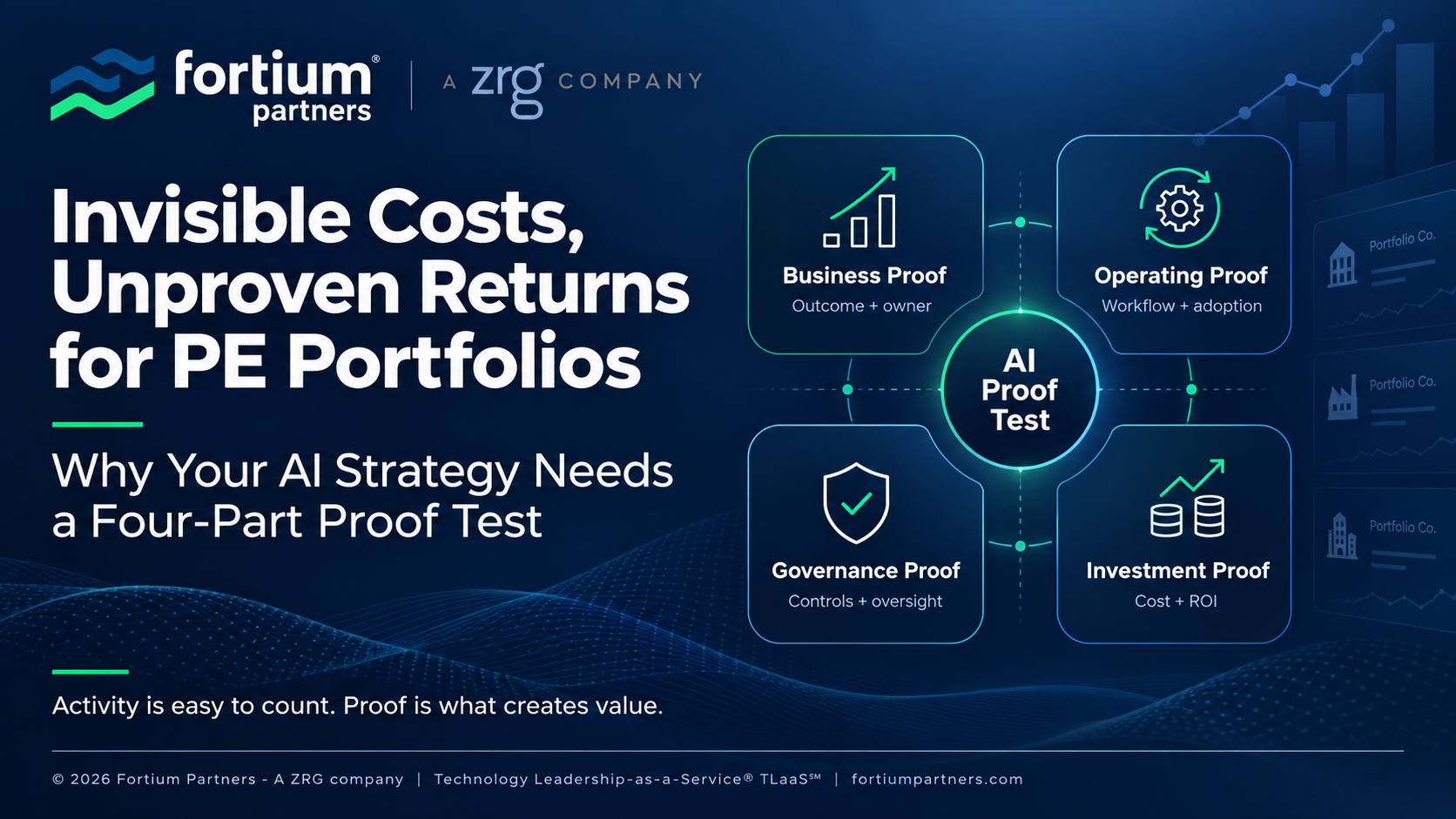
Apply the four-part AI proof test
The proof test is designed for portfolio reviews and funding decisions. A weak answer in one category does not automatically kill an initiative, but it identifies what must be resolved before more capital or exit-value credit is assigned.
1. Business proof
Start with the value creation lever. The use case should name the outcome it is intended to change, such as conversion, retention, cycle time, service cost, employee capacity, forecast accuracy, or risk exposure.
Then require four elements: the pre-deployment baseline, the expected change, the measurement period, and the executive accountable for the result. "AI improves productivity" is not a business case. "AI reduced average service-handling time from the agreed baseline over a defined period without lowering customer satisfaction" is a claim that finance can test.
2. Operating proof
An AI pilot becomes an operating capability only when it works inside the business. The company should identify the business owner, technology owner, affected workflow, adoption plan, data owner, and performance-monitoring process.
This is where promising pilots stall. A model can perform in a controlled test while the surrounding workflow, incentives, training, or data cannot support repeatable use. Operating proof shows that the result survives normal volume, staff turnover, exceptions, and management review.
3. Governance proof
Governance is not a compliance appendix. It is evidence that the company can explain what the system does, control where it operates, and respond when it fails.
At minimum, request an AI inventory, risk classification, data-handling requirements, human oversight criteria, vendor review, and incident escalation process. Grant Thornton's 2026 AI Impact Survey included 100 private equity fund leaders and found that only 9% were very confident they could pass an independent AI governance audit within 90 days. For an exit-bound company, undocumented controls create diligence work precisely when management attention is already constrained.
4. Investment proof
The return calculation should include implementation, model and platform charges, infrastructure, internal labor, change management, monitoring, vendor dependencies, and the cost of maintaining or replacing the capability. The denominator matters as much as the claimed benefit.
In IBM's 2026 global study of 2,000 technology executives, 85% lacked full visibility into real-time AI spend. The sample spans large organizations across 33 geographies, so it is not a mid-market PE benchmark. It is still a useful warning: AI cannot be defended as a value creation lever when its operating cost remains invisible.
The leadership question behind the proof gap
Proof gaps form when ownership is distributed but accountability is not. A Chief Technology Officer may own product or engineering delivery. A Chief Information Officer may own enterprise systems and data. A Chief Information Security Officer may own security controls, while the CFO validates financial impact and business leaders own adoption.
The company still needs one executive mandate connecting the business case, deployment, governance, and measurement. That does not mean every portfolio company needs a Chief AI Officer (CAIO). If AI is limited, low-risk, and contained within an existing technology leader's mandate, clarify decision rights and strengthen measurement. If AI crosses business units, affects regulated or customer-facing decisions, or creates material enterprise risk, additional CAIO or CISO capacity is warranted.
The leadership model should follow the evidence. A fractional executive fits a recurring accountability need before full-time decision volume exists. An interim executive fits a vacancy or transition that cannot pause. A consultancy fits a defined analysis or implementation project. A full-time hire fits a permanent, daily mandate central to the business model.
Economics should be compared on total commitment, not hourly rate. Review compensation or engagement fees, recruiting expense, ramp time, internal support, knowledge transfer, and exit or severance exposure. A fractional model also has real limitations: reduced daily availability, less accumulated context, and dependence on an internal sponsor. Defined escalation paths, a decision log, a named counterpart, and planned knowledge transfer mitigate those risks.
What the operating partner should request
Before approving more capital or giving AI credit in the value creation plan, request one evidence pack containing:
-
The use case and business objective
-
The baseline metric, measurement period, and result
-
The accountable executive and operating owner
-
The AI inventory and risk classification
-
Data, model, and vendor dependencies
-
Implementation and ongoing operating cost
-
Human oversight and incident-response responsibilities
-
The decision to scale, stop, or redesign the initiative
The evidence pack should be consistent across the portfolio while allowing the business metrics to vary by company. That creates a common screening discipline without pretending every portco needs the same AI strategy or leadership title.
Let the evidence determine the intervention
Fortium Partners, a ZRG company, helps PE operating partners and portfolio company leaders determine whether AI initiatives are producing measurable value, whether the organization has the executive capacity to scale them, and where operating or governance gaps weaken the value creation plan.
Through Technology Leadership-as-a-Service® (TLaaS™), Fortium activates fractional, interim, or virtual CIO, CTO, CISO, and CAIO leadership based on the actual gap. The right answer can be clearer decision rights for an existing leader, additional CISO oversight, stronger CIO ownership, or a time-bound CAIO engagement. The intervention should follow the evidence, not the title.
The strongest AI value creation stories are not the ones with the most pilots. They are the ones that can prove what changed, who owns the result, what it costs to operate, and whether the capability will remain valuable through the hold period—a critical requirement as Bain’s Global Private Equity Report 2026 highlights extending 7-year average hold periods and rising pressure on organic EBITDA expansion.
Frequently Asked Questions
How do we know our PE-backed company has an AI leadership gap (may need a CAIO)?
An AI leadership gap exists when your PE-backed company cannot connect AI activity to a measured business result, a reliable operating foundation, controlled risk, and one accountable executive. The clearest signs are missing baselines, conflicting ownership, untracked operating cost, undocumented controls, and no decision to scale, stop, or redesign weak use cases.
BCG's 2026 survey of 100 senior PE investors found that 76% cited unclear ROI as a blocker to digital-to-AI transformation. The diagnostic is therefore practical: ask what metric changed, who owns it, and what evidence a buyer would receive. If management cannot answer all three, strengthen the executive mandate before assigning more capital or exit-value credit.
Should our portfolio company use a fractional CAIO, consultant, or full-time CAIO hire?
A portfolio company should match the leadership model to its required decision frequency, operating scope, risk exposure, and need for durable executive accountability. A consultancy fits a defined analysis or implementation project. A fractional Chief AI Officer (CAIO) fits a recurring executive mandate before daily decision volume justifies a permanent seat. A full-time CAIO fits a business where AI is central to the product, operating model, or regulated decision environment.
An existing CIO or CTO remains the right owner when AI is limited, low-risk, and already inside that leader's mandate. A fractional CAIO adds value when accountability crosses functions but the need is not full-time. A full-time hire is the stronger choice when the company requires continuous executive presence, deep institutional context, and daily authority through the hold period.
What should our AI leadership budget include before the next funding decision?
An AI leadership budget should compare total commitments across the executive model, technology stack, internal operating support, implementation work, and transition risk rather than comparing hourly rates. Include compensation or engagement fees, recruiting expense, ramp time, internal support, model and platform charges, infrastructure, change management, monitoring, knowledge transfer, and exit or severance exposure.
IBM's 2026 study of 2,000 global technology executives found that 85% lacked full visibility into real-time AI spend. That enterprise sample is not a mid-market PE benchmark, but the control lesson applies: an ROI claim is incomplete when operating cost is invisible. Fractional engagements use a defined commitment and term, while full-time hires add compensation, benefits, recruiting, and separation exposure.
How does a CAIO improve ROI and exit readiness?
Executive AI leadership (interim, fractional, or virtual CAIO) improves ROI and exit readiness by connecting four disciplines that fragmented teams leave apart: business proof, operating proof, governance proof, and investment proof. The executive owner establishes a baseline, assigns operational responsibility, validates controls and dependencies, tracks total cost, and forces a decision to scale, stop, or redesign.
BCG reported in 2026 that PE-backed companies systematically building advanced AI capabilities across functions achieved nearly twice the return on invested capital of companies that did not. The result is not proof that every AI initiative deserves funding. It shows why disciplined foundations and cross-functional ownership matter. Buyers receive a repeatable evidence trail rather than a list of pilots, which strengthens diligence readiness and the credibility of the exit narrative.
What can make a fractional CAIO fail in our portfolio company?
A fractional AI leader fails when the portfolio company treats part-time executive capacity as a substitute for daily operating ownership, an empowered internal counterpart, and documented decision rights. The main risks are reduced availability during fast-moving decisions, less accumulated company context, weak follow-through between working sessions, and dependence on an internal sponsor who lacks authority.
Mitigation requires four operating controls: a named executive sponsor, a designated internal counterpart, documented decision rights and escalation paths, and a decision log with planned knowledge transfer. A fractional model is the wrong fit when AI is the core product, incidents require continuous executive presence, or the company refuses to assign internal ownership. Under those conditions, a full-time Chief AI Officer (CAIO) provides the depth and availability the mandate requires.
