
 Back
Back

|
Executive Highlights
|
An operating partner may receive ten AI requests in the first month after close. Sales wants a proposal assistant. Finance wants automated forecasting. Operations wants agents. Customer service wants a new agentic platform. Each request arrives with urgency, a vendor, and a promised return.
Approving a shared AI tool can feel like the fastest way to make progress. It rarely answers the harder question: which portfolio companies can convert AI activity into measurable value (ROI)?
BCG's 2026 survey of 100 senior PE investors found that nearly 30% already integrate digital levers during diligence. AI is moving earlier in the investment cycle. The first 100 days therefore need a decision process that converts diligence findings into an investment sequence.
A shared software stack is not a shared AI strategy
Central purchasing can improve security review, pricing, and vendor control. It cannot make ten businesses share the same workflows, data quality, customer economics, regulatory exposure, or leadership capacity.
A portfolio-wide tool rollout treats access as the constraint. In practice, the constraint is readiness. One company has reliable customer data and a disciplined sales process. Another has fragmented systems, unclear ownership, and no baseline for productivity. Giving both the same tool creates comparable licenses, not comparable value.
That distinction matters because infrastructure affects results. BCG found that building AI on mature digital infrastructure accelerated time to value by 40%. The figure does not promise the same outcome for every mid-market company, but it validates the sequencing principle: foundations first, scale second.
Run the AI Day-One Readiness Sprint
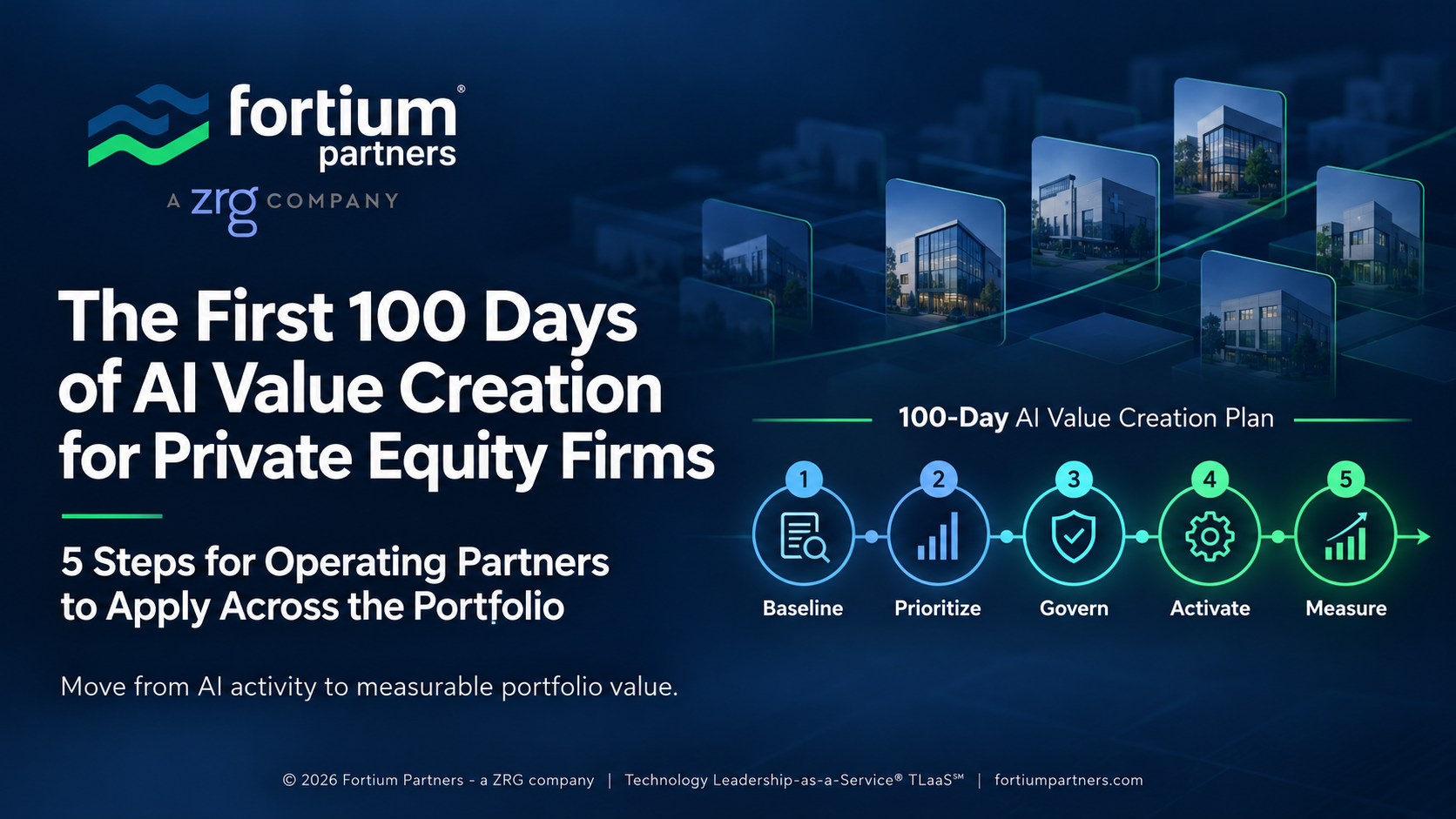
The sprint gives operating partners a common way to evaluate opportunities without prescribing one roadmap across the portfolio in only 5 steps.
1. Identify the Workflow
Name the three workflows with the strongest connection to the PE investment thesis. Focus on revenue growth, margin expansion, working capital, customer retention, cycle time, or risk reduction. A use case without a value-creation lever stays off the priority list.
2. Baseline the Outcome
Define the financial or operating metric before changing the workflow. Record the current result, measurement method, review period(cadence), and acceptable tradeoffs. Without a baseline, management can report adoption but cannot prove improvement.
3. Assign Accountability
Name one executive accountable for each outcome. Contributors can span technology, finance, operations, security, and the business unit, but shared participation cannot become shared ambiguity.
4. Test Readiness
Assess whether the data, security boundaries, vendor terms, integration architecture, workforce practices, and incident-response process can support controlled execution. The purpose is not to eliminate uncertainty. It is to expose the constraints that change performance, cost, timing, and risk.
5. Decide: Scale, Redesign, Defer or Stop
Place every initiative into one of four categories: scale, redesign, defer, or stop. The decision should reflect business value and readiness together. A high-value use case with weak foundations becomes a sequenced investment, not an automatic rejection.
Put ownership where the outcome lives
AI accountability should follow the business result. The business-unit leader owns workflow adoption and performance. The CFO validates the baseline and financial impact.
-
The CIO owns enterprise data, systems, and integration.
-
The CTO owns product and engineering implications.
-
The CISO owns security boundaries, third-party exposure, and response requirements.
No title automatically owns the entire agenda. When AI crosses functions or introduces material enterprise risk, the company needs an executive mandate connecting these decisions. That mandate can sit with an existing CIO or CTO, receive added CISO oversight, or require a time-bound Chief AI Officer based on scope and decision volume.
The resource plan should also be explicit. Compare internal capacity, advisory or implementation fees, fractional or interim leadership commitments, platform and integration costs, change-management needs, and knowledge-transfer requirements. Flexible leadership (fractional or interim CIOs, CTOs, CISOs) fits a defined gap before that decision volume increases. A full-time hire fits a permanent daily mandate.
Standardize the portfolio process, not the roadmap
At the fund level, standardize the intake template, value definitions, baseline requirements, risk tiers, evidence pack, decision categories, review cadence, and escalation rules. This gives the operating team comparable information across companies and a repeatable way to allocate prioritized activities/outcomes and capital.
Each portfolio company should own workflow selection, named executives, data remediation, operating redesign, user adoption, and the measured result. This separation supports the broader goal of aligning technology leadership with portfolio value without pretending that every company shares the same starting point.
It also treats technology as capital: sequenced against the PE investment thesis, governed through evidence, and evaluated by the outcome it produces.
The first 100 days reveal whether technology decisions have outgrown the leadership structure. Fortium Partners, a ZRG company, helps PE operating partners activate the CIO, CTO, CISO, or emerging AI leadership required for the actual mandate - for as much as you need and as long as you need it.
Through Technology Leadership-as-a-Service® (TLaaSSM), that capacity can be fractional, interim, virtual, or advisory. The objective is not to prescribe another permanent role. It is to provide executive accountability before the role exists and through every transition, including when a company needs CIO outcomes without a premature full-time hire. Now that Fortium is part of ZRG, PE firms can contact Fortium for interim/fractional technology leadership and stay with Fortium when the need for a full-time hire arises - because Fortium is now backed by ZRG’s talent across six continents.
The first 100 days should not end with an AI wish list. They should produce a defensible investment sequence: what moves now, what foundation comes first, who owns the outcome, and what evidence will determine the next decision.
Frequently Asked Questions
A newly acquired company is ready for AI when a high-value workflow has a measurable baseline, an accountable executive, usable data, defined security boundaries, and an operating team capable of adopting the change. Tool access alone is not readiness.
Test five areas during the first 100 days: workflow value, measurement discipline, executive ownership, operating foundations, and risk controls. BCG reported in 2026 that mature digital infrastructure accelerated AI time to value by 40%. The study covered 100 senior PE investors, so the finding supports portfolio-level sequencing rather than guaranteeing a result for one company. If the foundations are weak, fund the enabling work before scaling the AI use case.
A portfolio company should assign AI leadership according to the mandate's scope, decision frequency, risk exposure, and need for sustained executive accountability across the first 100 days and beyond. The existing Chief Information Officer (CIO) or Chief Technology Officer (CTO) is the right owner when AI remains inside enterprise systems, product, engineering, or data responsibilities.
A fractional Chief AI Officer (CAIO) fits a recurring cross-functional mandate before the company needs daily, permanent AI leadership. A full-time CAIO fits a company where AI is central to the product, operating model, or regulated decisions. A Chief Information Security Officer (CISO) should own security and risk controls, but not the business case by default. The strongest model gives one executive accountability while preserving clear roles for finance, technology, security, and business operations.
A 100-day AI leadership budget should capture the full cost of reaching a decision, not only software licenses or an executive's hourly rate. Include internal leadership capacity, advisory or implementation fees, fractional or interim commitments, platform charges, integration work, data remediation, security testing, change management, and knowledge transfer. In general, a company should allocate either 1.5%-3% of revenue toward an AI budget or at least 15-20% of total digital expenditures.
Compare those costs with the financial baseline and the cost of delay. A full-time hire also adds compensation, benefits, recruiting expense, ramp time, and separation exposure. Flexible leadership uses a defined commitment and term but still requires an empowered internal counterpart. Approve the budget only when the company can name the outcome, owner, evidence standard, and next decision.
The AI Day-One Readiness Sprint accelerates value creation by converting unranked post-close requests into five governed decisions tied to business outcomes, operating readiness, and the portfolio company's investment sequence. It moves each initiative through five decisions: identify the workflow, baseline the outcome, assign accountability, test readiness, and decide whether to scale, redesign, defer, or stop.
BCG found in 2026 that nearly 30% of surveyed senior PE investors already integrate digital levers during diligence. The sprint carries that work into the first 100 days by converting diligence observations into owned actions and measurable thresholds. Fortium Partners can provide the CIO, CTO, CISO, or time-bound AI leadership capacity needed to run that decision process when the portfolio company lacks the executive mandate internally.
An AI sprint fails when the fund standardizes tools instead of decisions, management skips the baseline, accountability is divided across functions, or the company scales before resolving data and security constraints. The result is a larger activity report without stronger evidence of value.
The practical safeguards are a three-workflow limit, one accountable executive per outcome, written scale-redesign-defer-stop criteria, and a review cadence tied to the value-creation plan. Flexible leadership also fails without an empowered internal counterpart, documented decision rights, and knowledge transfer. If AI requires continuous daily authority or sits at the center of the business model, the company should install full-time leadership rather than extend a temporary model beyond its fit.
