
 Back


>> 5 questions every leader needs to ask.
|
Executive Highlights
|
AI pilots are no longer scarce across private equity portfolios. Repeatable value still is.
BCG’s 2026 Applied AI Index, based on more than 1,300 C-suite respondents, found that nearly half of companies generate value from AI. Yet only 7.5% qualify as “future-built,” while 47% remain emerging. The portfolio question is: Which companies have the foundation to scale?
A demonstration can conceal inconsistent data, aging systems, brittle integrations, unclear controls, and fragmented ownership. Production exposes them.
Why a Successful Pilot Can Mislead the Investment Committee
Pilots use limited data, fewer users, manual oversight, and controlled workflows. Those conditions validate a use case, not operational readiness.
Production requires dependable inputs, integration, controls, monitoring, workflow ownership, and executive authority across technology, operations, finance, and risk.
Data maturity materially affects the ability to scale. BCG found that even among digital leaders, companies with the highest data maturity can scale twice as many solutions as those with lower data enablement.
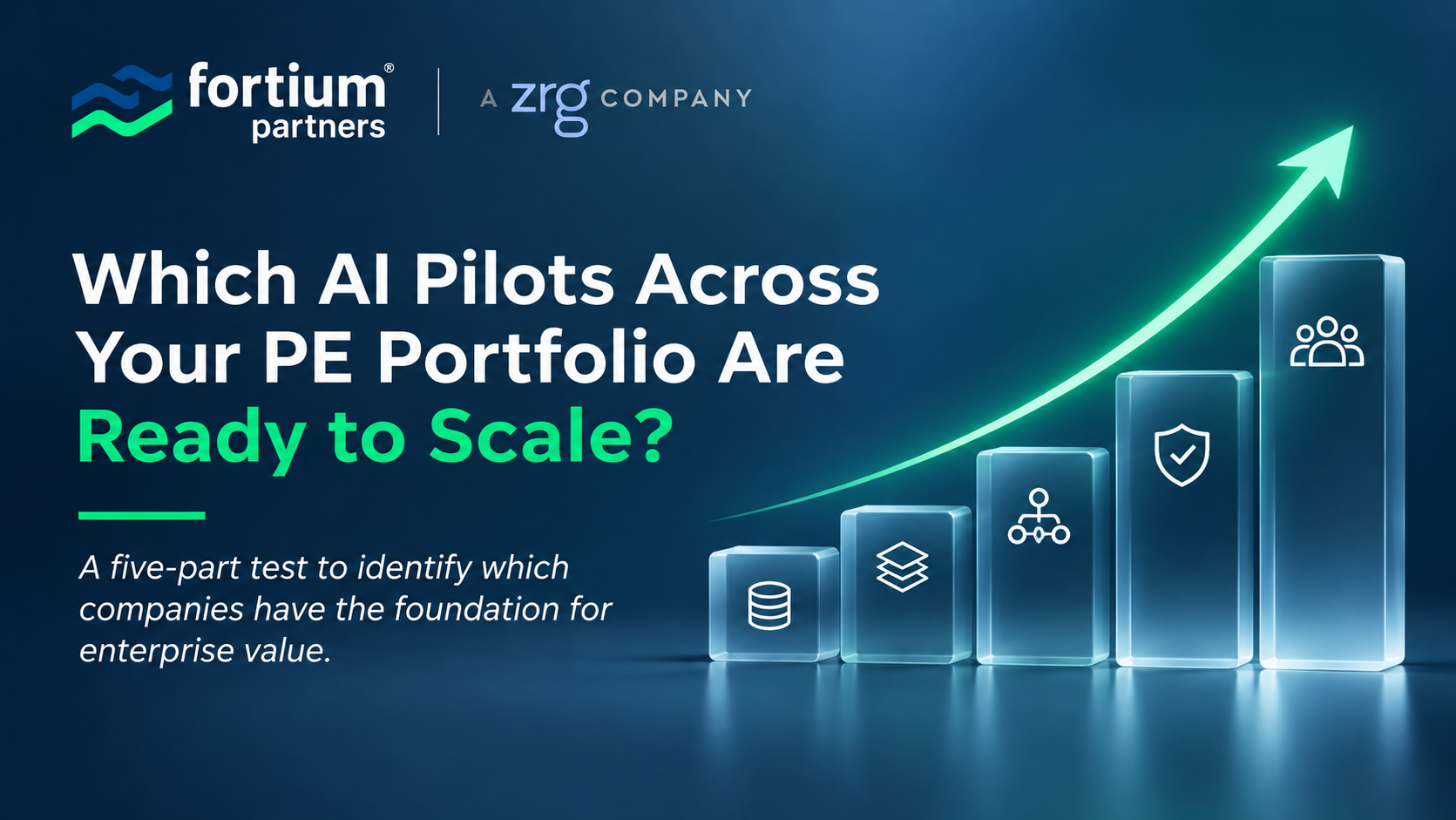
Apply the 5-Question AI Foundation Test
Before approving broader deployment, operating partners and portfolio executives should ask these five questions:
-
Data: Is source data accurate, governed, accessible, and assigned to an accountable owner?
-
Systems: Can ERP, CRM, and operational platforms support the workflow without creating another disconnected layer?
-
Integration: Are APIs, identity controls, monitoring, and workflow dependencies mature enough for production use?
-
Risk: Are privacy, security, vendor, human-oversight, and escalation requirements defined before deployment?
-
Leadership: Does one executive own the decisions connecting business value, technology delivery, adoption, and risk?
How to Assess Your Business: Score Your Readiness
Most AI initiatives don’t fail in the model. They fail in the foundation underneath it. Use the five statements below to see where your organization actually stands before you commit capital to deployment for each of the 5 questions above.
Rate each statement from 1 to 5. Be strict with yourself. Each statement contains several conditions, and you should give a high score only when all of them are true. If data is accurate but has no accountable owner, that’s a 3, not a 5.
The scale
|
Score |
Rating |
What it looks like |
|
1 |
Not in place |
No meaningful capability yet |
|
2 |
Ad hoc |
Exists in pockets, depends on individuals |
|
3 |
Partially in place |
Some elements defined, but gaps would block production |
|
4 |
Largely in place |
Defined and working, with a plan for the remaining gaps |
|
5 |
Production-ready |
Fully defined, owned, monitored, and auditable |
The five statements
-
Data: Source data is accurate, governed, accessible, and assigned to an accountable owner.
-
Systems: ERP, CRM, and operational platforms can support the workflow without creating another disconnected layer.
-
Integration: APIs, identity controls, monitoring, and workflow dependencies are mature enough for production use.
-
Risk: Privacy, security, vendor, human-oversight, and escalation requirements are defined before deployment.
-
Leadership: One executive owns the decisions that connect business value, technology delivery, adoption, and risk.
What your score means
Add your five ratings for a total between 5 and 25.
|
Total |
Readiness |
What to do next |
|
21 to 25 |
Ready to scale |
Move to production with standard controls in place |
|
15 to 20 |
Conditionally ready |
Pilot in a bounded scope while you close the gaps |
|
5 to 14 |
Not ready |
Fix the foundation before funding deployment |
One rule overrides the total. If Risk or Leadership scores a 1 or 2, treat the result as “Not ready” regardless of your overall number. Strong data and modern systems can’t make up for undefined controls or the absence of a single accountable owner. In regulated environments, these two gaps turn a promising pilot into an audit finding.
The lowest score in the assessment matters more than the total. Your weakest dimension is where your AI program will stall, so that’s where to invest first.
Scored 20 or below?
Contact us to see how our operating partners can close the gap in 90 days.
Strong Infrastructure Still Needs Operating Change
Technical readiness is necessary, but it is insufficient. PwC’s 2026 study of 1,217 companies found that 20% captured 74% of AI-driven returns. These leaders combined strong foundations with priority use cases, redesigned workflows, and adoption.
Before funding the next phase, portfolio leaders should ask:
-
Which financial or operating metric must improve?
-
What workflow and employee behavior must change?
-
Can the data and core systems support production use?
-
Who owns adoption, controls, and outcome measurement?
-
Which executive can scale, redesign, defer, or stop the initiative?
Your AI Is Already Running. Is Anyone Accountable for It? explains why policies and committees are insufficient without an accountable operating model.
Match Leadership to the Scaling Constraint
Here is how each Technology Leader adds value:
-
The CIO fits enterprise systems, data governance, integration, and operating alignment.
-
The CTO fits platforms, engineering, products, and technical scale.
-
The CISO owns security, privacy, third-party exposure, and incident readiness.
A specialized AI leader fits when use-case volume, regulation, or product strategy requires a distinct mandate. Beyond the CAIO examines how to avoid parallel authority.
Leadership design also affects value. McKinsey found that CEO oversight of AI governance is among the organizational elements most correlated with stronger self-reported bottom-line impact.
When the mandate is urgent or time-bound, fractional or interim leadership can add credible ownership and specialist depth. Leadership elasticity matches capacity to the transformation stage.
Through Technology Leadership-as-a-Service® (TLaaS℠), Fortium helps portfolio companies activate the leadership required to solve the next constraint.
Do not scale AI faster than the company can govern, support, adopt, and measure it. The first portfolio-wide standard should be the 5-question readiness test (above), not a shared technology purchase.
Frequently Asked Questions
Have Question? We are here to help
What is an AI data foundation for a PE portfolio company?
An AI data foundation combines governed source data, accountable ownership, accessible architecture, integration standards, identity controls, and monitoring. It provides reliable inputs and a traceable path between source systems, AI outputs, business decisions, and responsible owners.
Why can an AI pilot succeed while production deployment stalls?
A pilot limits users, data, integrations, and operating complexity. Production introduces broader workflows, system dependencies, security controls, adoption requirements, and executive accountability. A successful pilot validates the use case under test conditions, not the company’s readiness to operate it at scale.
What should PE operating partners ask before funding more or scaling AI?
Operating partners should ask which metric will improve, whether data and systems are ready, what workflow must change, who owns adoption and risk, and which executive can scale, redesign, defer, or stop the initiative. The answers should be company-specific, not imposed through one portfolio-wide roadmap.
Which executive should own the accountability to scale AI?
Ownership should follow the dominant constraint. A CIO fits enterprise systems and data integration, a CTO fits platforms and product engineering, and a CISO governs security and privacy. A specialized AI leader fits a sufficiently complex mandate, provided decision rights remain clear.
When should a portfolio company use fractional or interim AI leadership?
Fractional leadership fits a recurring need for executive judgment that does not require full-time coverage. Interim leadership fits a vacancy, urgent transformation, or transition where accountability cannot pause. Both require a defined mandate, executive access, measurable outcomes, and internal participation.
