 Back


|
Executive Highlights
|
How can a private equity (PE) portfolio company (portco) determine whether an AI initiative can scale without putting the value-creation plan at risk? Here’s a typical scenario: a portco approves an AI initiative to improve forecasting or customer service. The pilot performs well.
Then leadership asks:
-
which data it uses,
-
which vendors can access it, and
-
what happens if a critical integration is compromised.
How a PortCo answers these questions will determine the success of the initiative.
BCG's 2026 survey of approximately 300 cybersecurity leaders found that 89% reported AI-enabled attacks during the prior year. Yet only 41% had formal AI governance policies, and 23% monitored or logged AI agents. The gap is not simply cyber spending. It is the distance between what companies deploy and what their operating models can govern.
Why Cybersecurity Belongs in the Value-Creation Plan
AI changes both sides of the security equation. Attackers can accelerate reconnaissance, phishing, vulnerability discovery, and exploitation. Companies simultaneously add exposure through connected applications, cloud environments, third-party models, data pipelines, agent permissions, and unapproved tools.
IBM's 2026 Cost of a Data Breach research examined 602 organizations that experienced breaches. More than 20% reported a breach targeting an AI model or application, and 92% of that group lacked proper AI access controls. Compromised APIs, applications, plug-ins, and cloud misconfigurations were among the common causes.
Consequential AI security weaknesses often sit around the model: identities, integrations, data, infrastructure, and vendors. These dependencies affect continuity, customer trust, insurability, and exit readiness.
The AI-Cyber Value Protection Review
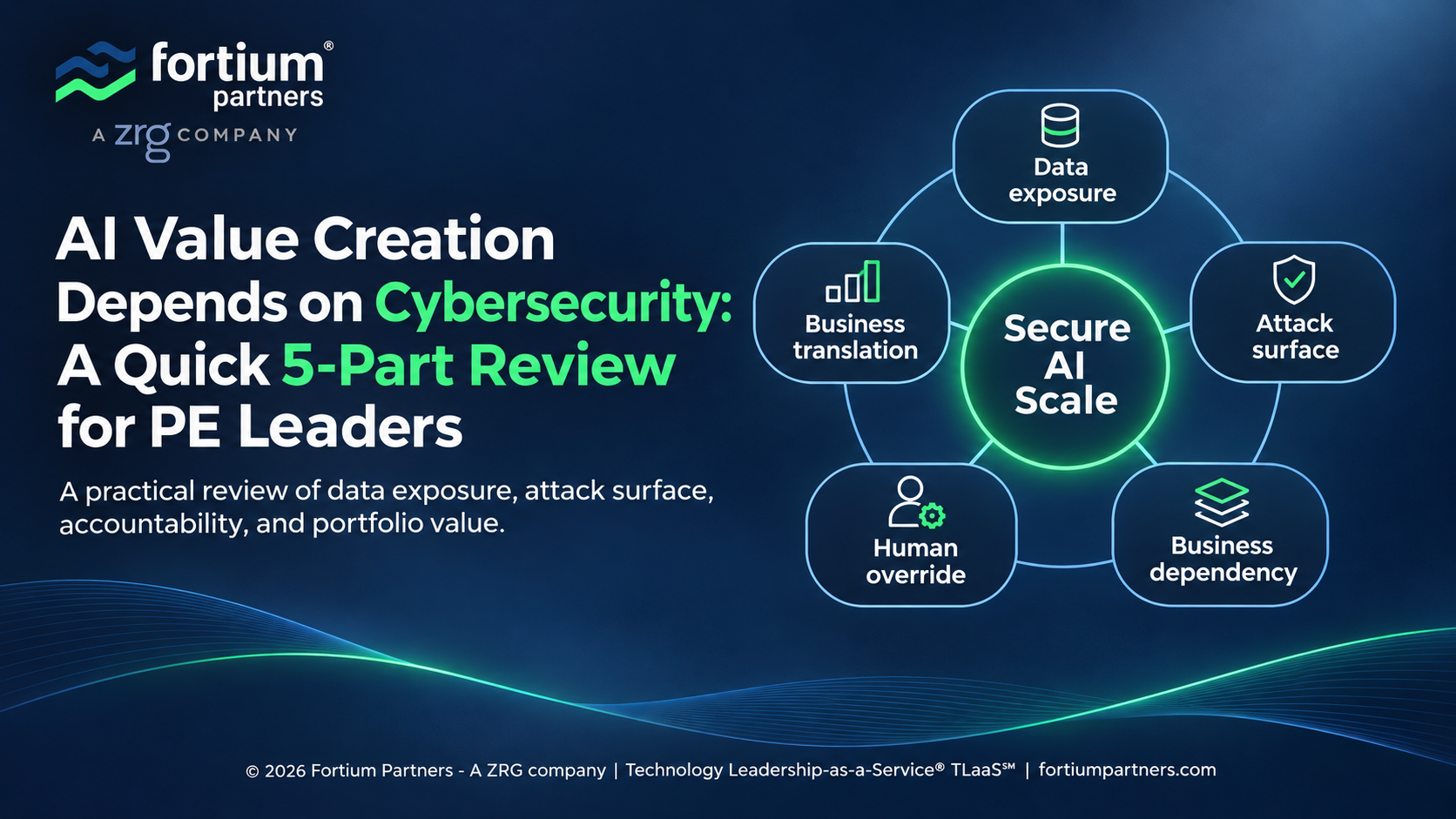
Before approving another AI investment, operating partners and portfolio leaders should test five areas:
-
Data exposure: What proprietary, customer, employee, or regulated data enters the workflow? Where does it move, and who can access it?
-
Attack surface: Which models, vendors, APIs, user groups, agents, and non-human identities introduce exposure?
-
Business dependency: Which revenue, customer, operational, or transaction processes would stop if the capability became unavailable or untrustworthy?
-
Human override: Who can suspend an automated decision, isolate the workflow, restore service, and coordinate the response?
-
Business translation: Can leadership express the exposure in revenue, cost, continuity, customer, insurance, and transaction terms?
The brief review should produce accountability: named owners, escalation paths, and investment decisions.
Accountability Must Cross the C-Suite
The CISO owns security architecture, identity standards, third-party risk, and incident response. The CIO owns enterprise integration, data governance, vendors, and the operating environment. The CTO owns product architecture, engineering, and secure development. The CFO tests the economics, insurance implications, and financial exposure. The CEO and board set risk tolerance and resolve material tradeoffs.
One executive must integrate those decisions. As Your AI Is Already Running. Is Anyone Accountable for It? explains, policies and committees do not replace accountable executive leadership.
Periodic compliance reviews are also insufficient for an environment that changes with every new model, integration, permission, or data source. Continuous exposure management gives leaders a current view of what is deployed, what it can access, which dependencies matter, and where intervention will protect the most business value. The CISO's 2026 Playbook explores that shift from technical reporting to decision-ready security economics.
The ZRG Fortium Perspective
Cybersecurity is part of the operating model that makes AI deployable, defensible, and sustainable. ZRG Fortium helps CEOs, boards, and PE operating partners establish credible CISO, CIO, CTO, and AI leadership through Technology Leadership-as-a-Service® (TLaaS℠), backed by a broader executive bench and continuity model.
The question is not whether AI creates cyber risk. It does. The executive question is whether the company has the leadership and visibility to scale AI without weakening its value-creation plan.
Take the Cybersecurity Confidence Index or contact ZRG Fortium to evaluate whether the current leadership and operating model can support secure AI scale.
Frequently Asked Questions
AI depends on data, integrations, identities, vendors, and reliable operating environments. Security weaknesses in those dependencies can delay deployment, interrupt workflows, weaken trust, and reduce the value an initiative can produce.
Standardize the questions, risk language, reporting expectations, and escalation requirements. Each portfolio company should retain ownership of controls and investments based on its business model, data, systems, and exposure.
The CISO typically owns security standards and response, but the CIO, CTO, CFO, business owner, CEO, and board retain defined decisions. One executive must integrate those responsibilities and own the outcome.
It is an ongoing process for identifying, prioritizing, and validating the exposures that matter most to the business as systems, identities, vendors, and threats change.
Activate experienced leadership when AI exposure exceeds the current CISO mandate or capacity, when no credible security executive is in place, or when diligence, integration, transformation, or an incident creates a time-bound leadership need.
