
 Back
Back

Listen to Blog
12:18
|
Executive Highlights
|
Cybersecurity concentration risk rarely appears in budgets. It becomes visible when the organization is under pressure and decisions depend on one executive's availability, judgment, or institutional knowledge.
For CEOs and PE Operating Partners, that dependency creates enterprise risk. A cyber incident, acquisition, audit, or leadership departure can expose whether the company has built a resilient security function or relies on a key individual.
Concentration Risk Is a Leadership-Design Problem
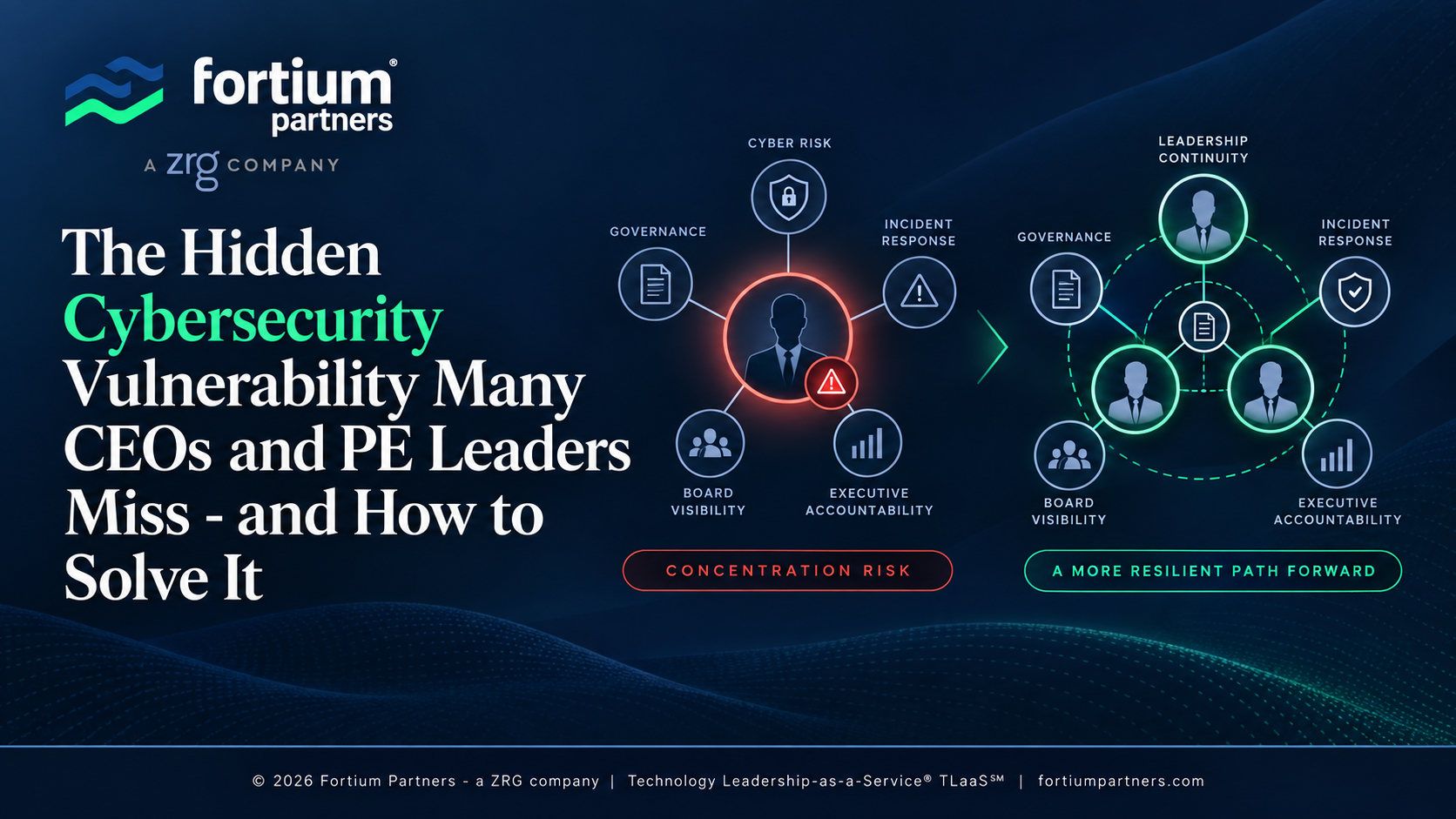
Cybersecurity leadership concentration risk occurs when too much executive judgment, accountability, or institutional knowledge sits with one person or one narrow layer of the organization.
The individual may be a CISO, CIO, IT director, or outsourced provider. The issue is not personal capability. The issue is whether the organization can maintain decision quality, escalation discipline, and board-level visibility when that person is overloaded, absent, or transitioning.
Concentration also appears when responsibility is distributed without a clear executive center. Security Operations, Legal, Finance, and the board can all participate while critical judgment still depends on one leader connecting their decisions.
Breach Cost Reveals Only Part of the Exposure
IBM's 2026 Cost of a Data Breach Report places the global average breach cost at $4.99 million, a 12% increase from the prior year. IBM attributes that increase to higher detection, escalation, and lost-business costs.
That figure does not capture the full leadership exposure. Slow escalation, conflicting recovery priorities, incomplete board communication, and undocumented decisions can extend disruption and its consequences.
Current research also shows how much pressure is accumulating around the security executive. Splunk's 2026 survey of 650 global CISOs found that 78% were concerned about personal liability for security incidents, while 41% could not correlate cybersecurity return on investment with risk mitigation and remediation.
That combination matters to executive teams. The CISO is being asked to carry broader accountability while also proving the business value of decisions across an increasingly complex risk environment.
Pressure Exposes the Single Point of Judgment
Leadership concentration often remains hidden during stable periods. It becomes visible when the business needs several high-consequence decisions at once. How?
-
During an incident, someone must determine what to contain, disclose, and restore first.
-
During an acquisition or CISO departure, someone must preserve the risk register, governance cadence, vendor context, and open commitments.
The World Economic Forum's Global Cybersecurity Outlook 2026 surveyed more than 100 CEOs and identified data leaks and increasingly capable adversaries as their leading generative AI security concerns. The harder question is whether the leadership structure can support that agenda under pressure.
More Tools Do Not Create Leadership Continuity
Additional tools, internal resources, and project consultants can address specific cybersecurity needs. They do not automatically create executive accountability or continuity.
Executive security leadership connects those capabilities to business priorities, establishes decision rights, and preserves judgment and context as circumstances change. Concentration risk therefore requires a leadership-model decision, not capacity alone.
The Two Leadership Gaps Require Different Responses
The Technology Leadership Credibility Gap exists when cybersecurity decisions have become executive-level, but no executive security leader has the authority and C-suite standing to own them. Fractional CISO leadership can close that gap when recurring executive judgment does not require full-time coverage.
The Technology Leadership Continuity Gap appears when a CISO departs or becomes unavailable. Interim CISO leadership can maintain governance, incident readiness, and decision momentum while the permanent structure is evaluated or a search proceeds.
A full-time CISO is stronger when regulatory obligations, scale, threat exposure, or decision volume require permanent daily ownership. Model selection should follow the mandate.
Cost comparisons should include full-time compensation, benefits, recruiting expense, ramp time, and severance exposure alongside the fractional or interim model's coverage, term, transition requirements, and monthly cost. The relevant question is which structure supplies the required accountability at the lowest total risk.
Why Concentration Risk Matters Across a PE Portfolio
PE-backed companies encounter cyber leadership pressure during diligence, integration, transformation, and exit preparation, often alongside ERP work, AI adoption, or vendor consolidation.
One overextended leader may lack the bandwidth to govern those priorities while maintaining incident readiness and sponsor reporting. The operating partner must determine whether the leadership model supports the value creation plan without creating a hidden dependency.
A portfolio-wide review should evaluate who owns cyber risk, how decisions escalate, what knowledge is documented, how the board receives information, and what happens if the current leader becomes unavailable.
The Fortium Perspective
Technology Leadership-as-a-Service® (TLaaS℠) treats cybersecurity leadership as an executive function the organization must sustain.
Fortium activates fractional or interim CISO leadership around the gap the business is experiencing. The model adds executive accountability and access to a broader technology leadership bench.
The objective is a more durable connection among
-
cyber risk,
-
executive decisions,
-
board governance, and
-
business continuity.
Executive Action: Test the Resilience of the Leadership Model
CEOs and PE Operating Partners can begin with five questions:
-
Who has final accountability for cybersecurity risk decisions?
-
Which decisions stop if that person is unavailable?
-
Where are incident, vendor, regulatory, and board-reporting judgments documented?
-
Does the current leader have the mandate and capacity the business now requires?
-
Would fractional, interim, or full-time CISO leadership best match the decision volume and risk profile?
Use the Cybersecurity Confidence Index to assess whether cybersecurity leadership, governance, and risk visibility are aligned with enterprise expectations.
Connect with Fortium to evaluate whether the current leadership model can sustain cybersecurity accountability through growth, disruption, and transition.
Frequently Asked QuestionsHow do we spot cybersecurity leadership risk in a mid-market company?Cybersecurity leadership is too concentrated when critical decisions, institutional knowledge, and executive communication depend on one person's availability. The clearest indicators are undocumented escalation paths, board reporting that only one leader can produce, vendor or regulatory context stored informally, and incident decisions that stall when that individual is absent. Splunk's 2026 survey of 650 global Chief Information Security Officers (CISOs) found that 78% were concerned about personal liability and 41% could not connect cybersecurity ROI to risk mitigation. Those findings do not prove concentration in a specific company, but they illustrate the expanding burden placed on the role. Concentration risk is present when the organization cannot preserve decision quality and accountability without its current security leader. Should our PE-backed company (or PE firm) use a fractional, interim, or full-time CISO?A PE-backed company should select CISO coverage according to its mandate and daily decision volume. A fractional CISO fits recurring executive oversight when the portfolio company needs board-level security judgment but not full-time coverage. An interim CISO fits a vacancy, leave, failed hire, or transition where leadership cannot pause. A full-time CISO is the stronger choice when regulatory requirements, operating scale, product risk, or incident volume demand permanent daily ownership. The investment stage also matters: diligence remediation and early value creation can support fractional leadership, while a departure during integration can require interim coverage. Fractional leadership should not win by default. The correct model is the one that supplies sufficient authority, availability, and continuity for the company's actual risk profile. How should our company compare fractional and full-time CISO costs?A fractional CISO cost comparison should measure total leadership cost and risk rather than hourly or daily rates. A full-time CISO cost includes base compensation, incentives, benefits, recruiting expense, onboarding time, equity where applicable, and severance exposure if the mandate or fit is wrong. A fractional engagement should be evaluated through its agreed coverage, monthly cost, term, escalation availability, knowledge-transfer requirements, and internal support needed between scheduled sessions. An interim engagement adds higher availability for a defined transition but still requires a deliberate handoff to the permanent model. How does a fractional CISO reduce cybersecurity risk?A fractional CISO reduces cybersecurity concentration risk by turning individual knowledge into an operating governance system. The executive establishes decision rights, documents escalation paths, creates a repeatable board-reporting cadence, clarifies incident roles, and connects security priorities to financial and operational consequences. Those mechanisms allow the organization to preserve judgment and accountability beyond any single meeting or individual. IBM's 2026 research places the global average breach cost at $4.99 million, with detection, escalation, and lost business contributing to the increase. A fractional CISO cannot eliminate that exposure, but the role can reduce avoidable delay and ambiguity around executive decisions. The model works best when the CISO has a named internal counterpart and enough authority to embed the governance system across functions. What are the risks of relying on a part-time CISO?A part-time CISO creates three genuine risks: limited availability during a live incident, less day-to-day organizational context than a full-time executive, and dependence on internal leaders to carry decisions between scheduled sessions. These risks should be addressed through an incident escalation agreement, a documented decision and risk register, a named executive sponsor, and explicit availability expectations before the engagement begins. Bench support can reduce single-person continuity risk, but it does not replace disciplined knowledge transfer or internal ownership. A company that requires continuous on-site leadership, handles unusually high incident volume, or cannot provide a capable internal counterpart should choose an interim or full-time CISO. Fractional leadership is an intentional model, not a universal substitute for permanent executive ownership. |
