
 Back


|
Executive Highlights
|
A company funds a modernization program, AI initiative, cybersecurity upgrade, or acquisition integration. Vendors are selected, and the objective is clear. Then progress slows.
The problem is not always the quality of the plan or the capability of the people involved. Technology decisions now cross operations, finance, security, data, talent, and customer experience. Moving forward requires a leader who can challenge assumptions, resolve tradeoffs, and earn commitment across the executive team.
More spending cannot compensate for missing executive credibility.
Capital, capacity, capability, and credibility solve different problems
Capital funds technology.
-
Capacity is the time available to oversee it.
-
Capability is the knowledge and experience required to understand the choices.
-
Credibility is the confidence that CEOs, boards, and functional leaders place in an executive’s judgment, independence, and ability to deliver.
The market contains capable technology executives and advisors. Capability matters, but it does not automatically create influence inside the C-suite. A leader can understand the technology and still lack the mandate, business fluency, or organizational trust required to align competing stakeholders.
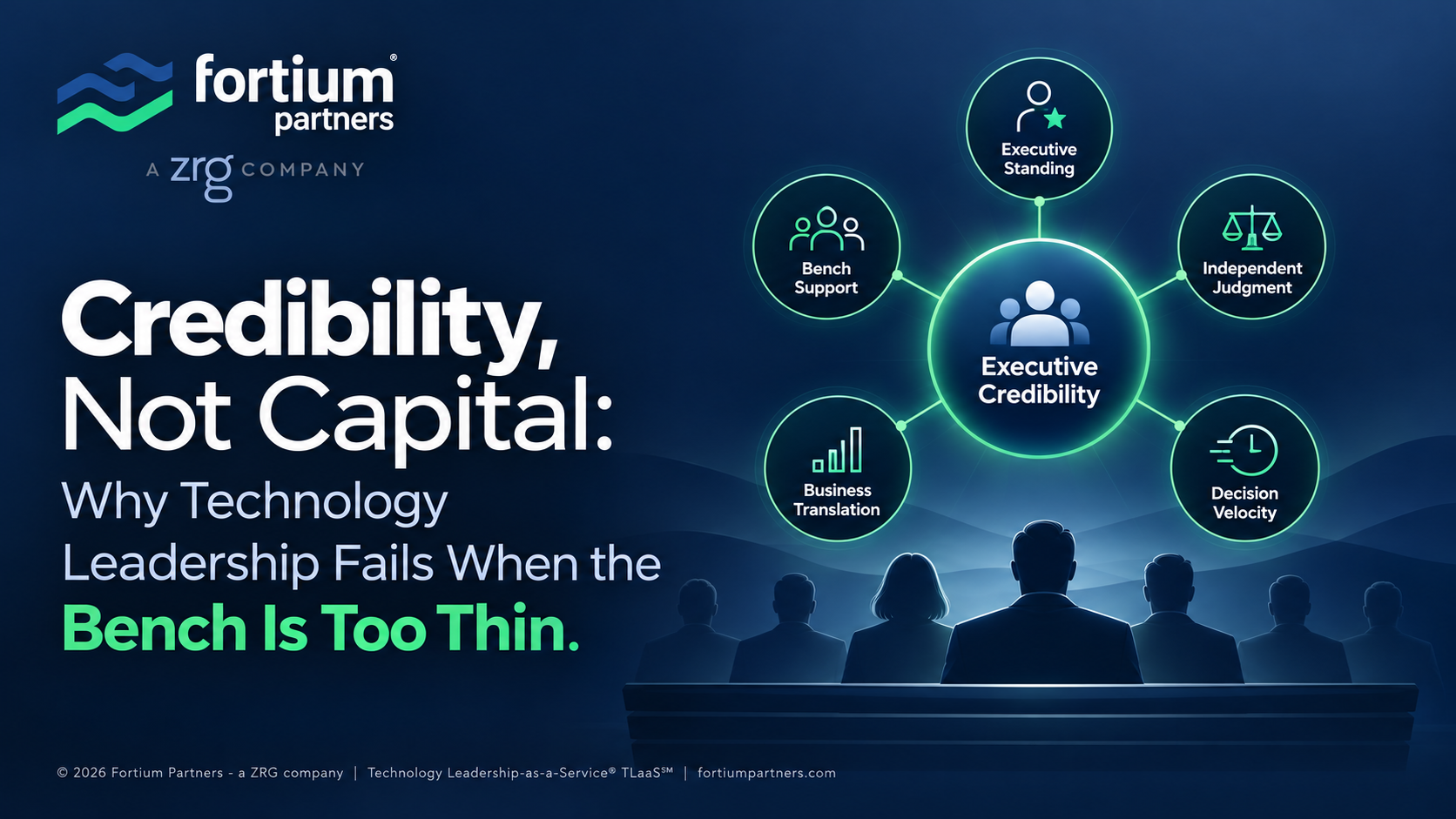
The Technology Leadership Credibility Gap opens when technology decisions become executive-level before the organization has a technology leader with the standing and authority to own them.Apply the technology leadership credibility test -
CEOs and boards can assess whether the organization has credible technology leadership across five dimensions:
-
Executive standing: Does the leader have the mandate to make decisions across functions, or only recommend them?
-
Independent judgment: Can the leader challenge internal assumptions and vendor recommendations without a competing agenda?
-
Decision velocity: Can the leader resolve tradeoffs at the pace the business strategy requires?
-
Business translation: Can the leader connect technology choices to growth, cost, resilience, customer experience, and enterprise value?
-
Bench support: Can the leader draw on specialist expertise and maintain continuity when the business need changes?
Credibility does not come from title alone. It is built through judgment, transparency, business context, and accountability for outcomes. It is sustained when the leader has access to a deeper bench rather than carrying every domain and decision alone.
That distinction also protects continuity. A credible leader can still create organizational risk when knowledge, relationships, and authority remain concentrated in one person. The Hidden Risk Every CEO Is Underestimating examines this exposure.
Match the leadership model to the credibility gap
The credibility test points to three possible actions. Strengthen the existing leader’s mandate when the organization has a capable executive who needs clearer authority, governance, or board access. Add fractional leadership when the business needs recurring executive judgment without full-time coverage. Use interim leadership when a vacancy, disruption, or transformation requires immediate credibility and continuity.
A permanent hire fits when the mandate and daily decision volume require sustained full-time ownership. Do You Need a Full-Time CIO - or Just the Outcomes One Delivers? compares these leadership models.
Fortium Partners does not claim that other technology leaders are incapable. Its distinction is credible executive leadership backed by an institutional bench. Through Technology Leadership-as-a-Service® (TLaaS℠), organizations gain access to experienced CIO, CTO, and CISO leaders who can operate with executive authority while drawing on broader specialist depth and continuity.
The practical question is not whether the organization has access to technical expertise. It is whether the business trusts its technology leadership to make consequential decisions - and whether that credibility can endure as conditions change.
Frequently Asked Questions
The Technology Leadership Credibility Gap exists when technology decisions have executive-level consequences but the organization lacks a technology leader with sufficient authority, business fluency, and organizational trust to own them. The gap appears in delayed decisions, vendor-led priorities, repeated escalation, and weak board translation.
Capability is the knowledge and experience to understand technology choices. Credibility is the trust and executive standing required to turn that knowledge into organizational decisions. A leader can be technically capable while lacking the mandate, independence, or cross-functional influence needed to move the business forward.
Fractional leadership fits a recurring need for credible executive judgment that does not require full-time coverage. Interim leadership fits a vacancy, disruption, transition, or time-bound initiative where accountability cannot pause. A permanent hire fits when daily decision volume requires sustained full-time ownership.
A bench gives the accountable executive access to specialist expertise, peer perspective, and backup when the business needs change. It strengthens the leader’s ability to make informed decisions while reducing dependence on one person for every technology domain, relationship, and escalation.
Yes. A company can clarify the incumbent’s mandate, improve board access, establish decision rights, introduce executive coaching, and add fractional or specialist support. The objective is to reinforce a capable leader with the authority and bench needed to operate credibly at the executive level.
