
 Back
Back

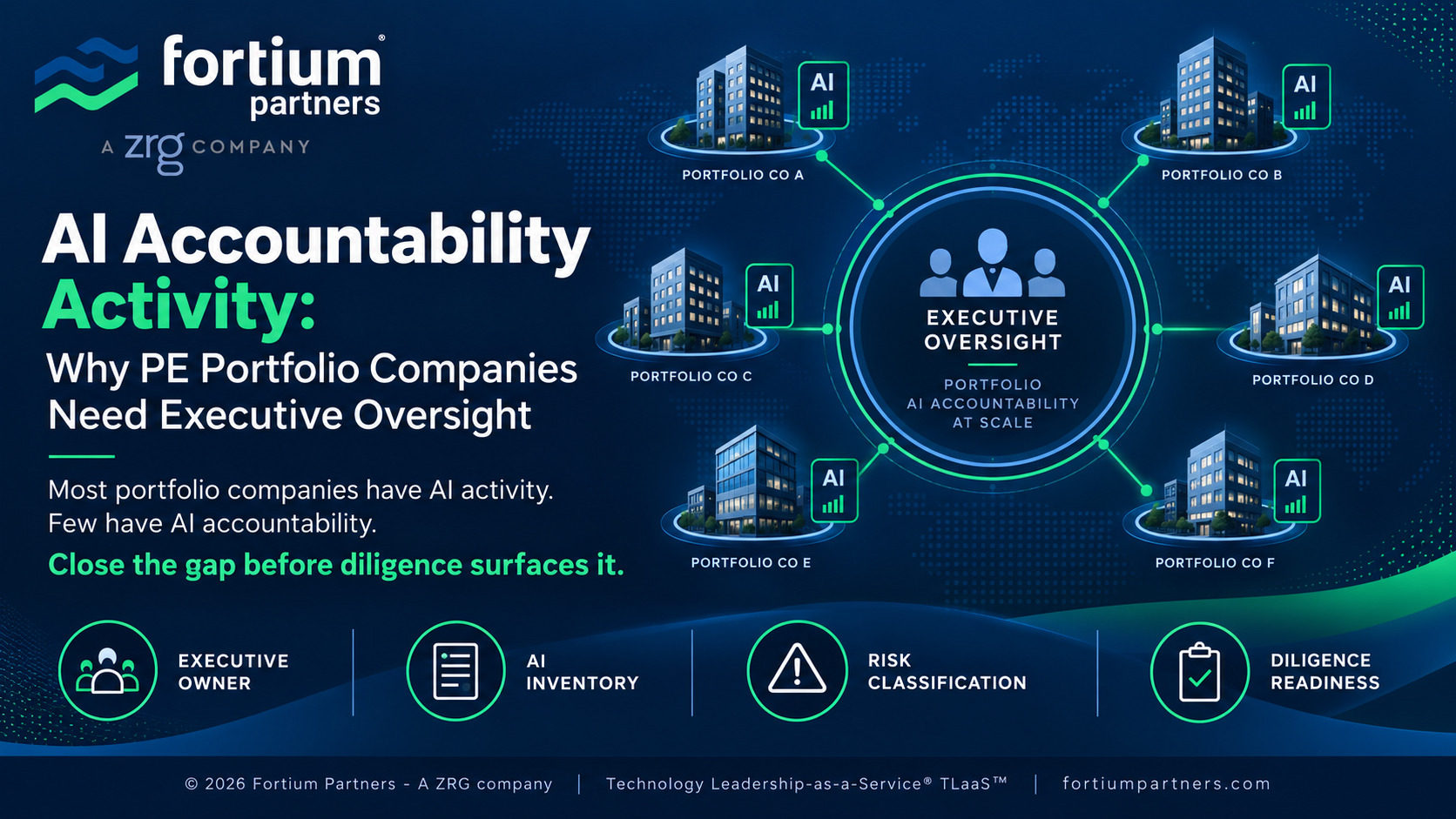
|
Executive Highlights
|
Most PE operating partners know which portfolio companies are using AI. They know which ones have licenses for Microsoft Copilot, ChatGPT, Claude, Gemini, or other AI tools. They also know which ones are running AI pilots and which ones have a CAIO or CTO who says the AI roadmap is on track.
What most operating partners do not know is whether any of those companies could answer a buyer's due diligence question about AI accountability today.
Not "what tools are you using?" That question is easy. The harder questions are: Who is the named executive responsible for AI outcomes? What is your risk classification model? Can you produce an AI inventory, including features embedded in your third-party SaaS tools? What is your escalation path when an AI system produces an unintended result?
In 2026, those questions are arriving earlier in the due diligence process. Proxy advisors, institutional investors, and strategic buyers are treating AI governance as a signal of management quality, not just a compliance checkbox. The operating partners who have a portfolio-wide answer to those questions will have a material advantage. The ones who discover the gap during due diligence will not.
The Distinction That Matters: Activity vs. Accountability
AI activity is visible:
-
Tools deployed
-
Pilots running
-
Productivity improvements reported.
-
Enterprise licenses purchased and partially adopted.
AI accountability is different. It requires three key dimensions:
-
named executive owner with defined decision rights over AI deployment. A risk classification model that distinguishes low-stakes internal tools from AI systems making decisions that affect customers, employees, or regulated data.
-
Documentation that would survive regulatory scrutiny or a buyer's technology review.
Most mid-market portfolio companies have the first. Very few have the second.
That gap is not a technology failure. It is a leadership architecture problem. And it is the operating partner's problem to solve, because it will not surface on its own until someone external asks the question.
Three Questions to Screen Your Portfolio
Before commissioning a full technology audit, operating partners can run a fast diagnostic across the portfolio with three questions directed at each company's CEO or technology leader.
-
Who is the named executive accountable for AI outcomes at this company, including decisions made by AI systems, not just the tools deployed?
-
Can that person produce an AI inventory and a risk classification today?
-
Would that answer satisfy a buyer's technology due diligence team in the next twelve months?
If the answer to the third question is uncertain, the company has an AI accountability gap. That is true regardless of how much AI activity is underway and whether the technology leader is a CIO, a CTO, or both.
Matching the Intervention to the Company
Not every portfolio company needs the same response. The right intervention depends on where the company sits on the AI maturity curve and how much time remains before a capital event.
When the current technology leader can own it: If AI use cases are internal, low-risk, and the CIO or CTO has sufficient bandwidth and explicit decision rights over AI governance, the intervention may need to clarify the mandate and establish governance rather than a new executive. The gap here is structural, not a leadership capacity issue.
When the mandate has been exceeded: If AI is entering customer-facing decisions, regulated workflows, or multi-jurisdictional data environments, and the technology leader is already stretched across cloud, security, product engineering, and transformation, the AI governance function likely needs dedicated executive leadership. A fractional or virtual Chief AI Officer can build the governance structure, establish the operating model, and transfer capability to the internal team within a defined engagement window.
When the timeline is compressed: If a capital event or exit is within twelve to eighteen months and the company cannot currently answer the three diagnostic questions, an interim or fractional CAIO engagement focused specifically on governance readiness may be the right intervention.
The operating partner's job is to match the model to the company's actual situation, not to apply the same structure across the portfolio.
The Portfolio-Level Framework
The technology leadership gap in PE portfolios is well understood. Credibility gaps and continuity gaps around CIO, CTO, and CISO roles have been a portfolio risk management concern for years.
AI governance is the same problem at a faster pace, with higher regulatory stakes and less institutional experience managing it.
Fortium Partners, a ZRG company, provides fractional, interim, and virtual CAIO leadership through Technology Leadership-as-a-Service® (TLaaS™). For PE operating partners, this means experienced AI executive leadership can be deployed at the portfolio company level without permanent headcount at each company, on a timeline and scope defined by the company's actual governance gap and exit horizon.
The goal is the same as every other executive leadership intervention in a PE portfolio: close the gap before it affects the value creation plan.
Connect with Fortium to assess which portfolio companies have exceeded their current AI governance capacity and where a targeted leadership intervention would close the gap before diligence surfaces it.
Frequently Asked QuestionsWhy is our portfolio company's AI activity failing to satisfy buyer due diligence?The failure occurs because buyers audit AI accountability, not AI activity. While portfolio companies easily report AI tools deployed and licenses purchased, very few can identify a named executive accountable for AI outcomes, produce a risk classification model, or present a documented AI inventory. This gap between active use and structured governance represents an unquantified valuation liability. In exit due diligence, proxy advisors and strategic buyers treat this lack of executive oversight as a signal of weak management quality. To pass a buyer's audit, the company must bridge this gap by establishing clear executive accountability over data handling, compliance, and risk. Should a PE portfolio company hire a full-time Chief AI Officer, use a fractional CAIO, or rely on a consultancy?Start to assess the maturity of AI use cases and the exit timeline to select the correct leadership model. If AI use cases are internal and low-risk, and the current CIO or CTO has the bandwidth, the existing technology leader should own it. A consultancy is suitable for short-term project scoping but does not provide leadership continuity. A fractional CAIO is the correct model when AI enters customer-facing decisions, regulated workflows, or complex data environments where the technology leader is stretched. For companies 12 to 18 months from an exit, a fractional CAIO establishes governance structures, builds an inventory, and transfers capability to the internal team without permanent headcount expense. If AI is core to the company's product and revenue, hire a permanent full-time CAIO. What does a fractional CAIO cost compared to a full-time AI executive?Compare total cost, not rate. A full-time technology executive's true cost includes base, bonus, equity, benefits, a recruiting fee of roughly 25–33% of first-year cash compensation, three to six months of ramp before independent judgment, and severance exposure if the fit is wrong. A fractional engagement is priced on a committed day or week count over a defined term, carries no recruiting fee or severance tail, and starts producing decisions in weeks rather than quarters. For example, standard client rates for fractional executives from Fortium Partners typically range from $2,000 to $3,000 per day (averaging approximately $2,300 to $2,500 daily), resulting in an annual cost of $180,000 to $300,000 for standard part-time commitments over a typical 6 to 18-month duration. The comparison that matters to a board is cost per decision made, not cost per hour purchased - which favors fractional until decision volume justifies a full-time seat. How does a fractional CAIO turn AI spending into measurable financial return?The mechanism is sequence, not technology. Companies achieving both cost and revenue benefit from AI are two to three times more likely to have embedded it across operations rather than layered tools onto existing processes (PwC, 2026), and only 25% have moved even 40% of pilots into production (Deloitte, 2026). A fractional Chief AI Officer runs a fixed sequence: baseline the current-state metric before deployment, kill use cases with no owner, redesign the workflow before automating it, and instrument the P&L line the use case claims to move. Fortium Partners places these executives as operators inside the business rather than as advisors to it, which is what makes the fourth step enforceable. What are the real risks of a full-time vs. a part-time technology executive, and how fast can they contribute?The genuine risks are three: reduced availability during a live incident, shallower institutional context than a long-tenured insider, and dependence on an internal sponsor to carry decisions between sessions. Each is mitigable - incident escalation path defined at engagement start, a documented decision log rather than tribal knowledge, and a named internal counterpart from day one - but a company unwilling to assign that counterpart should hire full-time instead. On speed: a fractional executive typically produces a diagnostic and a prioritized decision list within the first 30 days, against three to six months of ramp for a new full-time hire. The tradeoff is depth of context for speed of decision. |
